

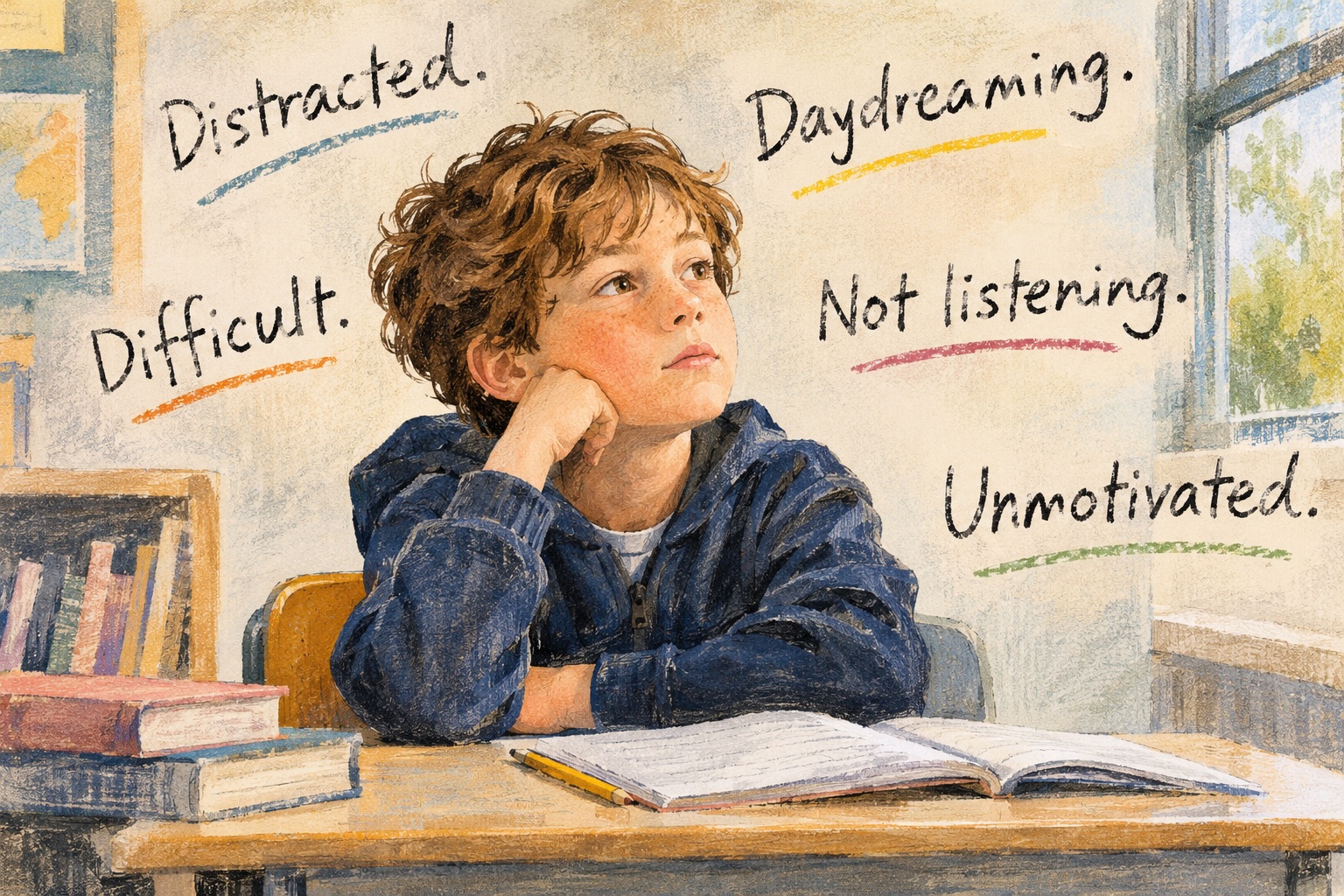
Disruptive. Defiant. Difficult. Demanding. Attention-seeking. Manipulative. Oppositional. Non-compliant. Emotionally immature. Inflexible. Disrespectful. Uncooperative.
We have developed an extraordinary vocabulary for describing children whose behaviour doesn’t meet our expectations.
Some of these words appear in school reports, professional assessments and conversations between teachers and parents. Others are used casually, often in moments of frustration. Over time, they can become part of how a child is known and understood.
What interests me is how many of these descriptions tell us more about an adult’s interpretation of behaviour than about the behaviour itself.
A child refuses to begin a task. We call it defiance.
A child interrupts repeatedly. We call it attention-seeking.
A child becomes distressed when plans change. We call them inflexible.
A child questions an instruction. We call them argumentative.
Sometimes these descriptions reflect genuine difficulties. But they rarely tell us enough about what is happening for the child.
And that matters, because the explanation we choose influences the response we give.
When a child has ADHD, the distance between what adults observe and what the child is actually experiencing can be particularly significant.
The question is not whether challenging behaviour exists. Of course it does. Parents, teachers and carers deal with genuinely difficult situations every day.
The more interesting question is whether the language we use helps us understand those situations or sometimes prevents us from looking any further.
Who is the behaviour actually challenging?
The term challenging behaviour is widely used in education, health and social care. It can describe behaviour that seriously affects learning, relationships, safety or everyday functioning.
But there is something worth examining in the term itself.
Who is being challenged, and by what?
Consider a child who frequently leaves their seat during lessons. Their teacher may find this disruptive because it interrupts teaching, distracts other pupils and makes classroom management more difficult. These are legitimate concerns.
But the description tells us very little about the child’s experience.
Are they seeking movement because remaining seated requires considerable effort? Have they lost track of the task? Are they overwhelmed by noise? Are they avoiding work they find confusing? Have they become frustrated after repeated attempts to concentrate? Or have they simply learned that leaving their seat produces an interesting response from the adults around them?
Any of these explanations might be relevant, and more than one could be operating simultaneously.
The point is that disruptive describes an effect of the behaviour. It doesn’t explain its cause.
The same applies to many other labels.
Non-compliant tells us that a child isn’t following an instruction. It doesn’t tell us whether they understood it, remembered it, could organise themselves to carry it out, disagreed with it or deliberately chose not to follow it.
Attention-seeking suggests that a child is trying to obtain a response from others. But seeking attention is not inherently problematic. Children need connection, reassurance, recognition and help. The important questions concern what the child is seeking, why, and whether the way they are seeking it is appropriate or effective.
Even manipulative, a particularly loaded description, often attributes a level of deliberate planning and intention that adults haven’t established.
This doesn’t mean children never deliberately influence other people. Of course they do. Social influence is part of human behaviour.
But there is a substantial difference between observing that a child repeatedly behaves in a particular way to obtain an outcome and concluding that the child has a manipulative character.
We need to distinguish what a child does from what we believe that behaviour says about who they are.
Otherwise, an interpretation can gradually become an identity.
Same child, different environment, different behaviour
One of the most revealing things about ADHD is how differently a child may function across situations.
Imagine a nine-year-old boy who talks constantly, interrupts others, struggles to wait and finds it almost impossible to remain seated during lessons.
At school, he is frequently described as disruptive and difficult to manage.
During a drama workshop, his spontaneity, enthusiasm and willingness to contribute are appreciated.
When discussing a subject he loves, he is knowledgeable, engaged and capable of maintaining extraordinary attention.
At home, when an activity captures his interest, he may demonstrate creativity and persistence that seem completely absent when doing homework.
Same child. Same ADHD.
Yet the descriptions of his behaviour can be remarkably different.
This doesn’t mean his ADHD disappears when he is interested in something. Nor does it mean that classroom expectations are unreasonable.
It means that a child’s ability to meet expectations is influenced by the relationship between their individual characteristics and the demands of the situation.
ADHD affects more than the ability to pay attention. It can influence inhibition, working memory, emotional regulation, task initiation, motivation and the regulation of activity.
These abilities are not necessarily available to the same degree in every situation. A child may manage a demanding activity when it provides immediate feedback, interest and stimulation, yet struggle to begin something apparently simple that offers little of these.
Adults sometimes interpret this inconsistency as evidence that the child could behave differently if they really wanted to.
After all, if they can concentrate for an hour on something they enjoy, why can’t they concentrate for fifteen minutes on homework?
But this reasoning overlooks an important feature of ADHD: being capable of doing something in one situation doesn’t guarantee being able to do it consistently in another.
The environment matters.
The demands matter.
The child’s current capacity matters.
And the way adults respond matters too.
When we describe behaviour as though it belongs entirely to the child, we risk overlooking all these influences.
When a label becomes an expectation
There is another reason to be careful with behavioural descriptions. Labels don’t simply communicate information. They can influence what adults expect to see.
Imagine two teachers receiving information about the same pupil.
The first is told:
“Oliver is oppositional and attention-seeking. He frequently challenges instructions, avoids work and disrupts lessons.”
The second is told:
“Oliver has ADHD and finds transitions, lengthy instructions and starting unfamiliar tasks particularly difficult. When overwhelmed, he may interrupt or refuse to begin. He usually responds better when instructions are broken down and someone helps him get started.”
Both descriptions could refer to the same observable behaviour. But they encourage very different interpretations.
The first prepares the teacher to anticipate resistance.
The second prepares the teacher to recognise situations in which support may be needed.
Neither description guarantees how the teacher will respond. Experienced professionals can recognise the limitations of labels, and the second description should still be checked against the child’s actual needs.
But expectations influence attention and interpretation.
When we expect defiance, hesitation may look like deliberate resistance. When we recognise possible difficulties with task initiation, the same hesitation may prompt us to investigate what is preventing the child from starting.
This can have consequences for what happens next.
Consider a familiar situation.
A child is asked to begin a written task. They sit without doing anything. The adult interprets this as avoidance and repeats the instruction more firmly. The child becomes increasingly frustrated. The adult raises the pressure, perhaps reminding them of consequences.The child refuses more openly.The adult concludes that the child is being oppositional.
What began as difficulty starting a task has developed into a confrontation.
Of course, not every refusal follows this pattern. Sometimes a child understands the instruction perfectly well and simply doesn’t want to do it.
But the example illustrates something important.
Sometimes, what we call escalating behaviour is partly an escalating interaction.
The adult’s response becomes part of the situation, influencing what the child experiences and how they react.
This is not about blaming parents or teachers. Adults are also working under pressure, managing competing demands and responding with the resources available to them.
It is about recognising that behaviour develops within relationships and interactions.
When we repeatedly interpret a child’s behaviour through the same negative label, we may inadvertently create the conditions in which that behaviour becomes more likely.
And the child may gradually begin to accept the description as part of who they are.

What happens when a child becomes ‘The difficult one’?
Children learn about themselves partly through the responses they receive from other people.
A child who repeatedly hears that they are lazy, disruptive, careless or difficult may begin to understand themselves through those descriptions.
This is particularly relevant for children with ADHD, who may experience frequent correction and negative feedback long before anyone recognises the reasons for their difficulties.
Imagine spending much of your childhood being told to try harder, stop interrupting, pay attention, calm down, think before acting and behave like everyone else.
You may genuinely want to do all those things. You may even understand exactly what is expected.
But understanding an expectation and consistently meeting it are not the same thing.
When effort repeatedly fails to produce the expected result, children may begin to question their abilities, intentions or character.
Some become increasingly defensive.
Some stop trying in situations where they expect to fail.
Some respond with anger or apparent indifference.
Others become intensely concerned with avoiding mistakes and disappointing adults.
These responses can then generate further labels.
The child who becomes defensive is argumentative.
The child who stops trying is lazy.
The child who becomes anxious about making mistakes is overly sensitive.
The child who tries to hide their difficulties is apparently doing fine.
This is how misunderstandings can accumulate.
The original difficulty becomes surrounded by secondary difficulties created, at least partly, through repeated experiences of failure, criticism or conflict.
Not every child with ADHD develops these patterns, and children’s responses are influenced by many factors. But it is important to recognise that the emotional consequences of repeated negative experiences can become as significant as the original ADHD-related difficulties.
By the time adults begin addressing the child’s behaviour, they may be dealing with years of accumulated frustration and damaged confidence.
What about the children whose behaviour doesn’t challenge anyone?
There is another side to this discussion that receives considerably less attention. We tend to notice children’s difficulties most readily when those difficulties affect other people.
A child who interrupts lessons, refuses instructions or expresses frustration loudly is likely to attract attention.
But what about the child who sits quietly, rarely complains and works extremely hard to meet expectations?
Imagine two pupils with ADHD.
One frequently interrupts, leaves their seat and argues when frustrated.
The other is quiet, cooperative and determined not to disappoint anyone.
The first is repeatedly discussed in meetings about behaviour.
The second is praised for being mature, responsible and well behaved.
Yet the second child may be struggling considerably.
They might spend enormous energy trying to concentrate, conceal confusion, suppress movement or monitor their behaviour. They may be anxious about making mistakes, exhausted after school or overwhelmed by demands that appear manageable from the outside. I know this experience personally. I was one of those children.
Their difficulties simply don’t create the same disruption for adults.
This raises an uncomfortable question:
Are we sometimes better at recognising children’s difficulties when those difficulties inconvenience other people?
This is particularly relevant when considering inattentive presentations of ADHD and children who mask their difficulties, including some girls whose ADHD may be overlooked.
However, we should be careful not to make the opposite assumption. A quiet, cooperative child isn’t necessarily masking or struggling. Many children genuinely feel comfortable in structured environments.
The point is that outward behaviour cannot tell us everything about internal experience. A child who appears compliant may be coping well. Or they may be struggling silently.
We need other ways of understanding their experience. And this brings us to an important distinction.
A child who causes fewer difficulties for adults is not necessarily a child who is experiencing fewer difficulties themselves.
This matters when we evaluate how well children are doing. A quiet classroom is not automatically an emotionally safe classroom. A child who follows every instruction is not automatically a regulated child. And a reduction in visible difficulties doesn’t necessarily mean that the underlying needs have been addressed.
Have we confused behaviour management with understanding behaviour?
Behaviour management has an important place in parenting and education. Children need boundaries, predictable expectations, opportunities to develop self-regulation and guidance about how their behaviour affects other people.
Evidence-informed behavioural approaches, including positive reinforcement, environmental adjustments and teaching alternative skills, can be particularly helpful for children with ADHD.
The problem arises when changing the visible behaviour becomes the only measure of success.
Consider a child who frequently calls out during lessons. A behaviour management strategy may successfully reduce the interruptions. That could be a positive outcome. Perhaps the child has learned to recognise the impulse, developed a strategy for waiting and received appropriate support.
But there are other possibilities. Perhaps the child has become frightened of making mistakes. Perhaps they are suppressing their need to ask questions. Perhaps they have learned that remaining silent is safer than risking another correction.
The observable result might look similar. The child’s experience is very different.
A reduction in challenging behaviour is not, by itself, proof that a child’s needs are being met.
We need to look beyond whether the behaviour has stopped.
Is the child learning?
Do they feel safe?
Are they developing useful skills?
Can they recognise when they need help?
Are they becoming more confident and independent?
Can they participate in everyday activities without constantly feeling that they are failing?
These questions don’t replace the need to manage behaviour. They help us understand whether our approach is producing meaningful progress. After all, the goal of supporting a child with ADHD should not simply be to make them easier for adults to manage. It should be to help them develop the understanding, skills and support they need to participate successfully in their own lives.
Understanding behaviour doesn’t mean accepting every behaviour
At this point, an important distinction needs to be made. Questioning behavioural labels does not mean dismissing the difficulties that parents, teachers and carers experience. Some children with ADHD display behaviour that is genuinely disruptive, aggressive, destructive or unsafe.
A child may hit another child, repeatedly interrupt learning, damage property or behave in ways that place themselves or others at risk.
These situations require clear and sometimes immediate responses.
Other children have co-occurring conditions, learning difficulties, trauma-related experiences or emotional and behavioural needs that require additional assessment and specialist support.
And children with ADHD, like all children, sometimes make deliberate choices that have consequences.
It would be inaccurate and unhelpful to explain every difficult behaviour as an involuntary expression of ADHD.
But recognising responsibility and understanding the influences on behaviour are not mutually exclusive.
Imagine a child who hits another pupil after becoming frustrated during a game. The immediate priority is safety. The behaviour must be stopped. The other child needs protection and support. The child who hit them also needs to understand that hurting someone is unacceptable.
But if we stop there, we may miss an opportunity to prevent the same situation happening again.
What contributed to the incident?
Was the child struggling to manage frustration? Had they misunderstood a social interaction? Were they already overwhelmed? Did they lack an effective way to communicate what they needed?
Or was there another reason?
Understanding these factors doesn’t remove accountability. It helps us decide what kind of learning and support is required.
A boundary tells a child what cannot happen. Support helps them develop the capacity to do something different.
Both are necessary.
The distinction is particularly important because children with ADHD may know what they should do without consistently being able to do it in the moment. Knowing that hitting is wrong is not the same as having fully developed the ability to inhibit an impulsive response when emotionally overwhelmed.
That doesn’t make the behaviour acceptable.
It tells us that repeating the rule may not be sufficient.
The child may need help recognising early signs of frustration, practising alternative responses, learning how to repair relationships and developing regulation skills in situations where they can actually use them.
Understanding behaviour should make our responses more effective, not less consistent.
Five questions worth asking before we respond
Changing how we understand behaviour doesn’t require parents and teachers to become psychologists.
It begins with asking slightly different questions.
These questions won’t explain every situation, and in moments of immediate danger, safety must come first. But they can help us move beyond automatic interpretations.
1. What exactly did the child do?
Try describing the behaviour without assuming intention or character.
Instead of She was manipulative, describe what she said or did.
Instead of He was deliberately disruptive, describe the interruption.
Instead of She was being difficult, identify the specific expectation she was struggling to meet.
This sounds simple, but it changes the starting point. It separates observation from interpretation.
And once we recognise that our interpretation is only one possible explanation, we become more open to considering others.
2. What was happening before the behaviour?
Behaviour has a context.
Was the child asked to stop an enjoyable activity?
Were they given several instructions at once?
Had they experienced a difficult social interaction?
Was the environment noisy or unpredictable?
Had they been concentrating for a long time?
Were they tired, hungry, anxious or already frustrated?
Sometimes the immediate trigger is obvious. Sometimes the behaviour reflects an accumulation of demands over several hours. A child who becomes distressed over something apparently minor may be responding to much more than the final event. Understanding the circumstances doesn’t automatically explain the behaviour, but it gives us somewhere useful to begin.
3. What ability was the situation asking the child to demonstrate?
This is one of the most useful questions we can ask about ADHD.
Everyday expectations involve abilities that adults often take for granted.
Starting homework requires more than knowing that homework needs to be done. It may involve stopping another activity, shifting attention, remembering instructions, organising materials, deciding where to begin and managing the emotional response to an unappealing task.
Waiting for a turn requires more than understanding the rule. It involves inhibiting impulses, tolerating delay, monitoring other people and maintaining awareness of the social situation.
Accepting an unexpected change may require cognitive flexibility, emotional regulation and the ability to adjust an anticipated plan.
These abilities develop over time, and ADHD can make their consistent use more difficult.
When a child repeatedly struggles with an expectation, it is worth asking whether we are treating a developing skill as though it were simply a matter of willingness.
4. How might my response be influencing what happens next?
This question can be uncomfortable, particularly for adults who are already exhausted.
But it is not about blame. It is about recognising that interactions work in both directions.
Does repeating an instruction more loudly help the child understand it?
Does discussing their behaviour in front of classmates increase embarrassment?
Does introducing consequences during emotional escalation help the child regain control?
Would reducing the amount of language, offering a brief pause or providing a clearer starting point change the situation?
Sometimes an adult’s response is entirely appropriate and the child still struggles.
But sometimes a small adjustment can prevent an interaction from becoming a confrontation.
We cannot control every child’s response.
We can, however, remain curious about the influence of our own.
5. What does this child need to learn, and what would help them learn it?
This is where understanding becomes practical.
If a child struggles with transitions, perhaps they need more predictable warnings and opportunities to practise moving between activities.
If they struggle to begin tasks, perhaps they need help identifying the first step.
If they interrupt frequently, perhaps they need support developing ways to participate without losing their thoughts.
If they become overwhelmed during conflict, perhaps they need opportunities to practise regulation and communication skills when they are calm.
The aim isn’t to eliminate every difficulty or remove every demand. It is to identify what the child is being asked to do, what is getting in the way and what support could make success more achievable.
This is a more productive starting point than simply asking how to stop the behaviour.
Changing the language is only the beginning
It would be easy to finish this discussion by suggesting that we replace negative labels with more positive ones.
Instead of disruptive, say energetic.
Instead of stubborn, say determined.
Instead of impulsive, say spontaneous.
There may be situations where reframing a child’s characteristics helps adults recognise strengths they have overlooked.
But simply replacing one label with another doesn’t necessarily improve our understanding. A child who repeatedly interrupts may indeed be enthusiastic and spontaneous. They may also have genuine difficulties with impulse control that affect their relationships and learning.
Calling them enthusiastic doesn’t remove those difficulties. Just as calling them disruptive doesn’t explain them.
The goal is not to find nicer words for the same behaviour. It is to become more accurate, more curious and more thoughtful about what the behaviour means.
Sometimes this means recognising an ADHD-related difficulty. Sometimes it means adjusting an environment. Sometimes it means teaching a skill, setting a boundary or seeking specialist support. And sometimes it means acknowledging that we don’t yet understand why something is happening.
That uncertainty is not a professional weakness or a parenting failure. It is often a more useful starting point than a confident but inaccurate explanation.
Perhaps we need to reconsider what success looks like
Parents and teachers understandably want children to manage everyday expectations. We want them to participate in learning, develop friendships, respect boundaries, become more independent and manage their emotions.
These are reasonable goals.
But there is a difference between helping children develop these abilities and expecting them to demonstrate them consistently before they have the necessary skills or support.
There is also a difference between a child who has learned to regulate their behaviour and one who has learned to hide their difficulties.
If we measure success only by how little disruption a child causes, we risk overlooking important aspects of their development and wellbeing.
Perhaps progress is a child who can recognise when they are becoming overwhelmed.
Perhaps it is a child who asks for help instead of withdrawing.
Perhaps it is a child who can recover from frustration more quickly, repair a relationship after a conflict or begin a difficult task with less support than before.
These changes may not always be immediately visible to everyone around them.
But they matter.
They represent the development of skills, confidence and self-understanding that children can carry into adolescence and adulthood.
And ultimately, that is what good support should help achieve.
The question we should keep asking
Children with ADHD can behave in ways that are difficult to understand and challenging to manage. Acknowledging this doesn’t make us less compassionate or less informed.
But we need to be careful about what happens when a description of behaviour becomes an explanation of the child.
A child who refuses isn’t necessarily defiant.
A child who interrupts isn’t necessarily seeking attention.
A child who struggles with change isn’t necessarily stubborn.
And a child who follows every instruction isn’t necessarily coping well.
None of these behaviours has a single, universal explanation.
The words we use can help us communicate genuine concerns. But they can also narrow our thinking, shape our expectations and influence the opportunities children receive to be understood differently.
We don’t need to abandon boundaries, expectations or responsibility. We need to become more thoughtful about how we interpret children’s difficulties and more interested in the conditions that help them succeed.
Because the most important question may not be why a child is challenging our expectations.
It may be whether our expectations and the assumptions behind them are allowing us to understand the child at all.