

If you’ve ever thought:
“Why is my child doing this again?”
“Didn’t we already deal with this?”
“Do consequences mean absolutely nothing to them?”
“Am I too soft… or is my child just not learning?”
…welcome. You are not alone.
And you are not failing.
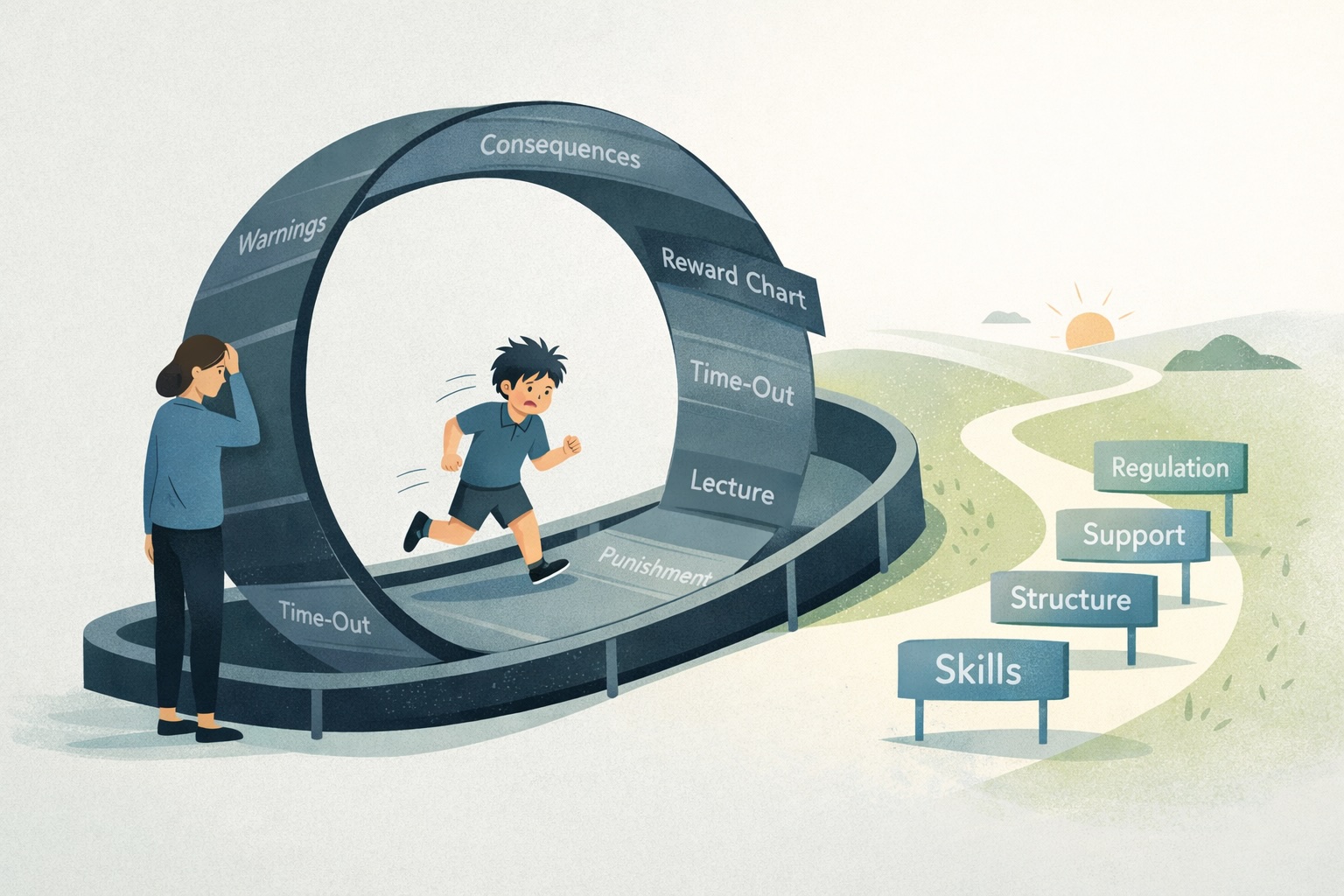
You might simply be stuck in what I call the ADHD Discipline Trap – a cycle where parents try harder and harder to discipline, while the child seems to respond less and less.
It’s exhausting. It’s confusing. And it can quietly erode your confidence as a parent.
But here’s the truth most parenting advice doesn’t say clearly enough:
Rewards and punishments don’t build self-control in ADHD children because ADHD impulsivity is not a “motivation problem.” It’s a brain timing problem.
And once you understand that, everything changes.
What Parents Mean When They Say “Discipline Isn’t Working”
When parents tell me discipline isn’t working, they usually mean:
They’ve tried consequences. They’ve tried reward charts. They’ve tried removing screen time. They’ve tried taking away treats. They’ve tried time-outs, warnings, counting to three, sticker systems, “if you do this then you’ll get that.”
They’ve also tried the classic parenting cocktail:
repeating the same instruction 12 times
raising their voice
giving “the look”
delivering long speeches about respect
threatening consequences they don’t want to enforce
feeling guilty afterwards
promising themselves they’ll stay calm next time
and then… losing it again next time
And the part that really breaks parents?
The behaviour repeats.S ometimes within the hour. And that’s where the panic begins. Because parents start asking themselves a bigger, scarier question:
“What if my child just doesn’t care?”
Let’s address that head-on.
The ADHD Discipline Trap (And Why It Feels Like You’re Parenting a Brick Wall)
The ADHD Discipline Trap is the loop many families fall into:
Your child acts impulsively → you react with discipline → your child melts down, argues, denies, shrugs, or laughs → you escalate consequences → your child feels overwhelmed or ashamed → the behaviour repeats → you feel furious and hopeless → connection breaks down → your child becomes even more reactive.
And now you’re not just dealing with impulsivity.
You’re dealing with:
resentment
shame
emotional explosions
daily conflict
and a child who seems to be “getting worse”
The trap happens because most discipline strategies assume one thing:
That the child has enough pause between impulse and action to make a different choice.
But ADHD often removes that pause. So the child isn’t choosing to ignore consequences in the way adults assume. They’re often reacting faster than their thinking brain can catch up.
And that’s why traditional discipline feels like it’s bouncing off them. Not because they’re bad. Because their brain works differently.
Why Rewards and Punishments Don’t Build Self-Control in ADHD Kids
This is the part that most parenting advice gets wrong.
It assumes discipline teaches self-control.
But ADHD impulsivity isn’t caused by a lack of understanding.
Or laziness.
Or defiance.
Or “not caring.”
It’s caused by how the ADHD brain processes time, emotion, and impulse.
Let’s break this down in a way that actually makes sense.
1. ADHD Impulsivity Happens Before Thinking Kicks In
When a neurotypical child is about to do something impulsive, there is usually a small internal pause: “Hmm. I shouldn’t do this. I might get in trouble.”
That pause might be tiny, but it exists.
In ADHD, that pause can be delayed or missing. The impulse arrives like a speeding train.
So instead of:
Impulse → pause → decision
You often get:
Impulse → action → regret
This is why ADHD kids so often say things like:
“I don’t know why I did it.”
“I didn’t mean to.”
“I forgot.”
“It just happened.”
And honestly? They’re not lying. Their brain often acts first and processes later.
Punishment doesn’t teach a pause that isn’t neurologically available in the moment.
2. ADHD Brains Struggle With “Future Consequences”
Most discipline relies on delayed learning: “If you do X, then later you will lose Y.”
But ADHD brains are notoriously bad at future thinking. Not because they’re unintelligent. Because ADHD disrupts executive functioning.
The future feels vague. Unreal. Foggy. The present feels loud, urgent, intense.
So when a child is overwhelmed, excited, frustrated, bored, or overstimulated, their brain doesn’t think: “If I do this, I will lose screen time tonight.”
It thinks: “I NEED to do this right now.”
That’s why consequences don’t feel like “lessons.” They feel like random punishments that appear later.
3. Working Memory Fails Under Stress
Working memory is the ability to hold information in your mind while acting. In other words: remembering the rule while your emotions are boiling. That’s difficult for many children. It’s significantly harder for ADHD children.
So a child might genuinely know the rule: “Don’t hit your sibling.”
But in the moment, when their body is flooded with anger or frustration, their brain can’t hold the rule in focus long enough to stop the action.
Then afterwards they feel confused, ashamed, or defensive. And parents interpret this as: “They don’t care.”
But often the truth is: They couldn’t access the rule in time.
4. Emotional Dysregulation Hijacks Logic
Here’s the part parents rarely hear explained properly: When your child is dysregulated, they cannot learn.
You cannot teach a child self-control while their nervous system is in fight-or-flight.
Punishment during dysregulation often does one of two things:
escalates the emotional explosion
or triggers shutdown, defiance, denial, or “I don’t care” behaviour
So instead of learning, the child experiences:
threat
humiliation
rejection
panic
or intense shame
And shame is not a learning environment. It is a survival environment.
The Big Myth: “They Don’t Care”
Parents often say:
“He doesn’t care. He just shrugs.”
“She laughs when I tell her off.”
“He looks bored while I’m losing my mind.”
But ADHD children often do care. They just don’t show it the way adults expect.
Some ADHD children respond to stress in ways that can easily be misunderstood. They might laugh, argue, deny what happened, act silly, shut down, or shrug as if they don’t care – not because they’re being rude or arrogant, but because their nervous system is overwhelmed. In those moments, their brain goes into survival mode, and the behaviour you see is often a protective response: avoiding shame, fear, or emotional overload. Sometimes it’s easier for them to look “unbothered” than to admit they feel upset, guilty, or out of control. Because if they admit they care, they also have to face the painful feeling that they’re failing – and many ADHD kids already carry far too much of that.
The ADHD Truth Nobody Says Loudly Enough
Here it is: You cannot punish a child into executive function.
You can’t consequence your way into self-regulation.
You can’t sticker-chart your way into impulse control.
You can’t “discipline” your way into a nervous system that can pause.
Self-control is not a moral achievement.
It’s a neurological skill.
And ADHD kids need support building that skill, not harsher discipline.
So What Actually Builds Self-Control in ADHD?
This is where things get hopeful. Because ADHD kids absolutely can build better self-control.
But the process is different. Self-control in ADHD is built through three stages:
Regulation → Reflection → Repetition
Let’s break this down.
Step 1: Regulation (Calm the Nervous System First)
A dysregulated child cannot access learning. So your first goal is not discipline. It’s stabilisation.
This does not mean “letting them off.” It means recognising that you can’t teach during emotional chaos.
Regulation strategies can include:
movement breaks (jumping, running, stretching)
sensory tools (fidgets, chewing, deep pressure)
calming music or white noise
reducing verbal input (talk less, guide more)
predictable routines
quiet spaces
co-regulation (your calm nervous system helping theirs)
And yes, I know how frustrating that sounds. Because in that moment you want justice. You want consequences. You want the behaviour to stop. But regulation is what allows the brain to re-enter thinking mode. Without it, you’re arguing with a nervous system.
Step 2: Reflection (After the Storm, Not During It)
Reflection is where learning happens. But it must happen after the emotional intensity has dropped. This is where many parents accidentally sabotage progress, because they try to do the “lesson” in the heat of the moment.
Reflection should be short, calm, and specific.
Instead of:
“Why do you always do this? What is wrong with you? We’ve talked about this!”
Try:
“That was a big reaction. What was happening in your body right before you shouted?”
Or:
“Let’s rewind. What could we do next time when you feel that rush?”
Or even:
“Your brain went into fast mode. Let’s practise the pause.”
Reflection should feel like coaching, not interrogation.
Step 3: Repetition (Because ADHD Skills Are Built Through Practice)
ADHD children do not learn skills once. They learn them through repetition. Like learning a musical instrument. Or learning to ride a bike. You wouldn’t expect a child to master violin after one lesson. But we often expect ADHD children to master emotional regulation after one conversation.
Self-control improves when the child practises in low-stress moments.
That means you don’t just talk about self-control after a meltdown.
You practise it:
before school
during transitions
during games
during sibling interaction
during screen time boundaries
during everyday frustration
The goal is to make the “pause” automatic.
Practical Strategies That Work (Without Becoming a Full-Time Prison Warden)
Let’s get practical. Here are some high-impact strategies that help ADHD impulsivity and emotional outbursts.
1. Create a “Pause Routine” (Not a Lecture)
Most ADHD children don’t respond well to long instructions in the moment. But they can respond to a short routine they’ve practised.
For example:
Pause Routine:
Stop
Breathe
Reset
Try again
The key is that the word becomes a cue, not a criticism. You are training the nervous system, not arguing with it.
2. Pre-Correct Instead of Punish
This is one of the most effective ADHD parenting strategies and it’s strangely underused. Pre-correcting means you intervene before the situation triggers impulsivity.
Example:
Instead of waiting for your child to interrupt guests and then punishing them, you say beforehand: “When you feel the urge to interrupt, tap my arm. I’ll help you get your turn.”
Instead of waiting for the meltdown at homework time, you say: “Let’s do five minutes, then we move. We’ll use the timer.”
Pre-correction feels proactive, not reactive. And ADHD kids do better with proactive.
3. Make the Rules Visible (Because ADHD Memory Is Not Reliable)
If you feel like you’re constantly correcting your child – “Don’t shout,” “Stop interrupting,” “Be respectful,” “Use kind hands,” “Calm down” – you’re not alone. And with ADHD, the problem often isn’t that your child doesn’t know the rules. It’s that their brain struggles to hold the rules in mind when emotions and impulses take over.
That’s why it helps to reduce everything into three simple, visible house rules that cover most situations. For example:
Speak respectfully
Keep hands safe
Fix what you break
The goal isn’t to create a perfect household poster. The goal is to give your child a clear “reset cue” in the moment. Instead of long lectures, you can calmly say: “Which rule are we on right now?” or “Try again – respectfully.”
This can work especially well for ADHD kids because it lowers emotional escalation, reduces power struggles, and makes boundaries easier to remember – even when their brain is overloaded.
4. Reduce Talking During Conflict (It Doesn’t Help as Much as You Think)
This one is hard for many parents because we believe talking equals teaching. But when a child is dysregulated, your words become background noise. Even worse: they become fuel.
In the heat of the moment, use fewer words.
Try short scripts like:
“I’m here.”
“Not safe.”
“We’ll talk later.”
“I’m stopping this.”
“Pause.”
“Reset.”
Less talk. More structure. That’s ADHD parenting gold.
The Discipline Swap: What to Do Instead of Punishment
Let’s talk about consequences. Because yes – boundaries matter. And yes – children need limits.
But ADHD children respond better to consequences that are:
immediate
short
connected to the behaviour
paired with repair
delivered calmly
Here are practical swaps:
Instead of… “No screens for 3 days”
Try:
“Screens are paused for the next hour. We reset, then you earn back access through repair.”
Instead of… “Go to your room until you calm down”
Try:
“We’re taking a regulation break. You can be in your room or on the sofa, but we’re pausing interaction.”
Instead of… “Say sorry right now!”
Try:
“We’ll repair this after you calm down. Then you can choose how to make it right.”
This is not soft parenting. It’s strategic parenting.
Why Punishment Often Makes ADHD Impulsivity Worse
This is the part that shocks many parents: punishment can actually make ADHD impulsivity worse. Not because your child is spoiled or “doesn’t care”, but because punishment increases stress – and stress is the fastest way to shut down executive function. When a child feels threatened, ashamed, or overwhelmed, their brain becomes less able to pause, think, or self-regulate. That’s why harsh discipline often leads to more outbursts, more arguing or denial, more shutdown, and even more negative self-talk. Parents then feel like they’re losing control and naturally escalate consequences… and the child becomes even more dysregulated. That’s how families get stuck in the ADHD discipline trap, even when everyone is trying their best.
The Hidden Link Between Impulsivity and Negative Thinking
Many parents focus on the impulsive behaviour itself, but miss what’s happening underneath. For many ADHD kids, impulsivity doesn’t just lead to trouble – it leads to a painful internal story: “What’s wrong with me? Why can’t I stop myself?” Over time, that can turn into shame, anger, and constant negative thinking, like “I’m stupid,” “Nobody likes me,” “I always mess things up,” or “I hate school.” And once a child feels ashamed, they become even more reactive, not less.
Tools That Can Help ADHD Kids Build Self-Control (And Save Your Sanity)
If your child struggles with impulsivity, emotional outbursts, or constant negativity, tools aren’t “extra.” They’re often the missing scaffolding.
Here are a few ADHD-friendly tools that support emotional regulation and impulse control.
1. Visual Timers (One of the Best ADHD Parenting Purchases You Can Make)
ADHD kids often struggle with transitions because time feels vague and invisible – five minutes can feel like five seconds, or like an eternity, depending on the mood. A visual timer makes time concrete and predictable, which can dramatically reduce meltdowns and resistance. It’s especially useful for homework, screen time, morning routines, bedtime, and switching between activities. The real magic is that it removes you from the role of “bad guy” – instead of constantly negotiating or arguing, the timer becomes the neutral boundary.
2. Sensory Tools (Because Regulation Is Physical, Not Just Mental)
Many ADHD kids need sensory input to stay regulated.
Useful options include:
fidget tools
chew necklaces
wobble cushions
resistance bands on chair legs
sensory putty
textured keychains
These aren’t distractions.
They’re regulation supports.
When the body is regulated, the brain has a better chance of pausing.
Check out the sensory tools kit for ADHD kids (#ad).
3. Weighted Blankets or Deep Pressure Tools
Deep pressure can be calming for some children (especially those with ADHD + anxiety traits).
Weighted blankets(#ad) can help:
bedtime emotional dysregulation
sleep routines
nervous system calming
winding down after school
Not every child likes them, but for some families they are genuinely life-changing.
When You Should Seek Extra Support
Sometimes impulsivity is more than “typical ADHD chaos,” and it’s worth seeking extra support. If aggression is escalating, school is constantly calling, your child is being excluded or socially isolated, anxiety feels intense, or you’re hearing painful self-hatred like “I’m stupid” or “I hate myself,” those are important red flags. The same applies if meltdowns are frequent and extreme, or if you find yourself feeling anxious or even afraid of your child’s reactions. Parenting an ADHD child is challenging, but it shouldn’t feel like living in a constant emotional minefield. Support isn’t a luxury – it’s often the stabiliser that helps the whole family breathe again.
Final Thoughts: Why Discipline Fails (And What Works Instead)
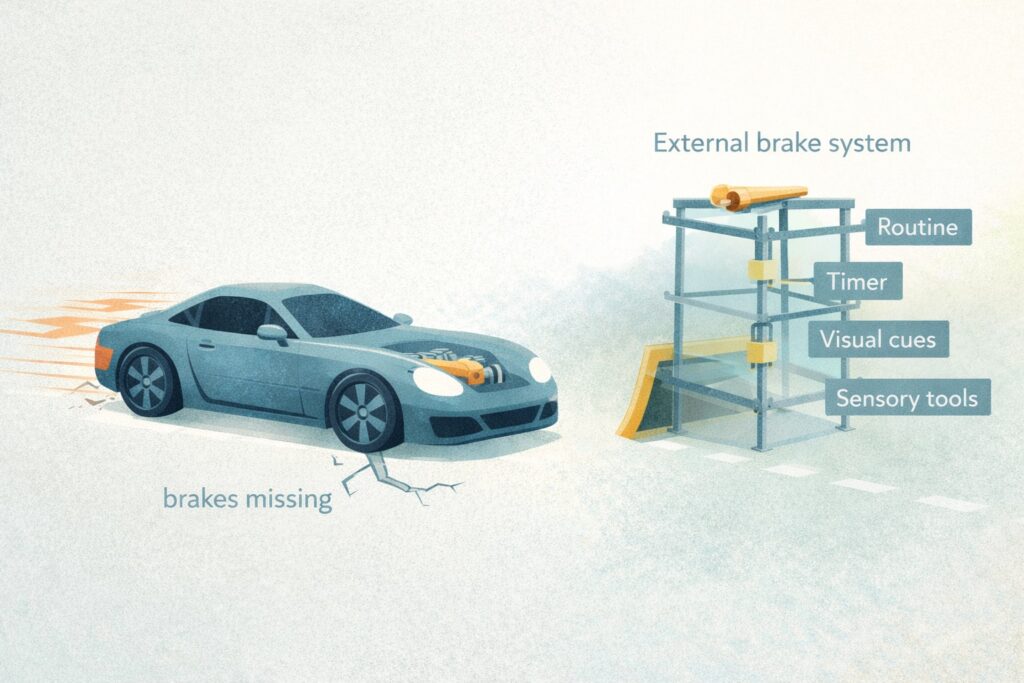
If discipline hasn’t worked in your home, it doesn’t mean your child is broken – and it certainly doesn’t mean you’re a weak parent. It usually means you’ve been using strategies designed for a brain that can pause and think before reacting. ADHD impulsivity often happens too fast for logic, rules, or future consequences to kick in, which is why harsher punishment rarely helps. What actually builds self-control is emotional regulation, external structure, predictable routines, supportive coaching language, repair after conflict, and repeated practice over time. In other words, ADHD kids don’t need stronger consequences – they need stronger brakes. And once you stop trying to “discipline the ADHD out of them,” you can finally start helping them build the skills they’ve been struggling to access all along.