
A recent BBC article “ADHD has rewired the workplace. This is what it means for bosses and workers” highlighted the growing number of employment tribunals involving neurodiversity in the workplace and accommodations for neurodivergent employees. Much of the discussion has focused on whether employers are doing enough to support neurodivergent staff.
I think we’re asking the wrong question.
The conversation around neurodiversity at work has changed significantly over the past few years. Awareness has increased, more organisations have introduced neurodiversity policies, and workplace accommodations have become a familiar part of conversations about inclusion.
These are undoubtedly positive developments.
Yet many neurodivergent employees continue to experience burnout, disengagement, poor performance reviews and, in some cases, formal workplace disputes. If awareness has never been higher, why are so many people still struggling?
Perhaps the answer isn’t that organisations need more workplace accommodations.
Perhaps it’s that many workplaces are still designed around the assumption that everybody thinks, processes information and manages attention in broadly the same way.
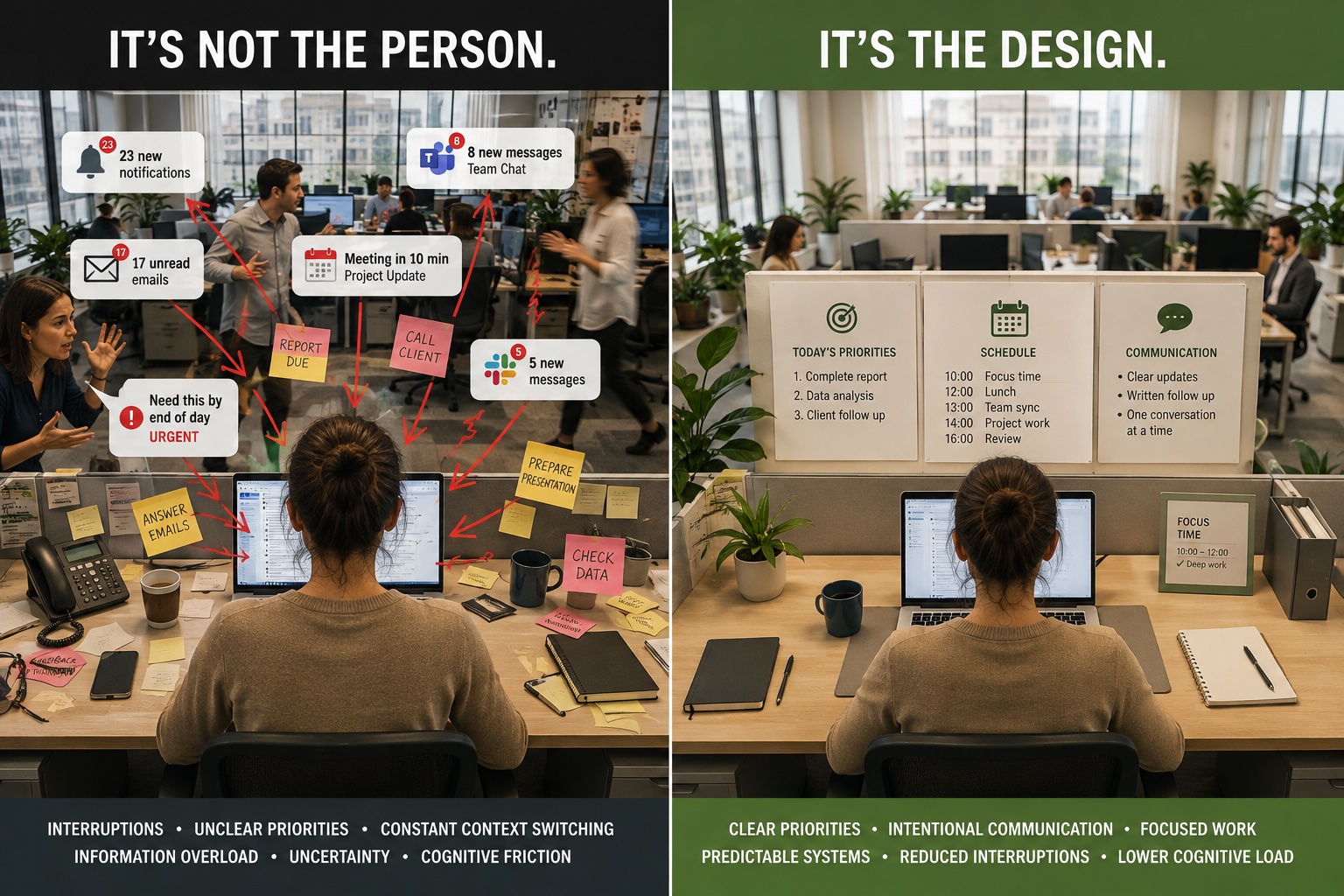
The problem isn’t always the individual.
Sometimes it’s the design of the workplace itself.
We keep trying to adapt people instead of redesigning work
Imagine a building with steps leading to every entrance. Providing someone with a better pair of crutches might help them reach the door. Installing a handrail might help a little more.
But neither solution asks the more important question:
Why was the building designed this way in the first place?
Workplaces often approach neurodiversity in much the same way.
An employee says they’re overwhelmed. The organisation offers noise-cancelling headphones.
Someone struggles to stay on top of competing priorities. They’re offered flexible working hours.
An autistic employee finds meetings exhausting. Written agendas are introduced.
These adjustments may genuinely help, and in many situations they are entirely appropriate. But they often focus on helping the individual adapt to a system that remains fundamentally unchanged.
Instead of asking:
“What accommodation does this employee need?”
Perhaps organisations should also be asking:
“What is it about the way we’ve designed work that makes this unnecessarily difficult?”
That is a very different conversation.
Most workplaces were designed for one cognitive style
Many organisations unintentionally assume that everyone can comfortably work in the same way.
They assume people can switch attention between multiple priorities without losing momentum. That verbal instructions will be remembered. That “urgent” means the same thing to everyone. That employees instinctively know which task matters most when several arrive at once. That people can process information in long meetings, recover quickly from interruptions and regulate their attention consistently throughout the day.
For many neurodivergent people, these are not minor inconveniences. They are continuous cognitive demands.
The work itself may not be difficult. What becomes exhausting is constantly deciding what deserves attention, interpreting unclear expectations, recovering from interruptions, managing uncertainty and trying to keep multiple streams of information organised at the same time.
From the outside, two colleagues may appear to be doing exactly the same job. Internally, one may be carrying a significantly heavier cognitive load simply to produce the same outcome. Most organisations never see this hidden work because it is invisible.
The hidden cost of cognitive friction
When people think about workload, they usually think about the number of tasks someone has to complete. In reality, workload is only part of the picture.
The other part is cognitive friction. Cognitive friction is the unnecessary mental effort created by the way work is organised rather than by the work itself.
It appears every time priorities constantly change without explanation. Every time an employee has to search through multiple systems to find information. Every time meetings end without clear actions. Every time expectations remain vague. Every time someone has to interrupt deep concentration because another “urgent” request arrives.
Individually, these moments seem insignificant. Collectively, they become exhausting.
This is one of the reasons why neurodivergent employees often describe feeling mentally drained long before they have actually completed a full day’s work.
The problem is not necessarily the volume of work.
It is the amount of cognitive energy required simply to navigate it.
Why accommodations often become sticking plasters
This doesn’t mean workplace accommodations are unhelpful. Far from it. Many adjustments make a meaningful difference and should absolutely remain part of inclusive employment practices.
The difficulty is that they often operate at the level of the individual rather than the system.
One way to think about workplace support is through three different layers.
The first is environmental support. This includes changes such as quieter workspaces, adjusted lighting, hybrid working or sensory accommodations.
The second is practical support. This might involve written instructions after meetings, flexible hours, assistive technology, task planning or alternative communication methods.
Both are valuable and, in many organisations, increasingly well understood.
The third layer is cognitive support, and this is where workplaces often stop too soon. Cognitive support focuses on reducing unnecessary mental effort rather than simply changing the environment.
Instead of asking whether someone needs headphones, it asks why interruptions are constant.
Instead of asking whether flexible hours would help, it asks why priorities are changing so frequently.
Instead of assuming executive functioning difficulties sit entirely within the individual, it examines whether the way work has been designed is creating unnecessary cognitive load for everyone.
This shift in thinking is subtle, but it changes everything.
What better workplace design actually looks like
Designing work differently doesn’t necessarily require expensive programmes or major restructuring.
Often, it begins with asking better questions.
Could priorities be made clearer?
Could unnecessary interruptions be reduced?
Could meetings finish with agreed actions rather than assumptions?
Could expectations be made explicit instead of relying on unwritten workplace rules?
Could communication become more predictable?
Could fewer systems be used to manage work?
These are not “special adjustments” for neurodivergent employees.
They are examples of better organisational design.
The irony is that improvements made for neurodivergent employees often make work easier for everyone else as well.
Clear communication benefits everybody.
Predictable feedback benefits everybody.
Reduced ambiguity benefits everybody.
Better designed systems reduce stress across entire teams.
This is the same principle used in architecture.
A ramp designed for wheelchair users also helps parents with pushchairs, delivery workers and travellers with luggage.
The best workplace design follows exactly the same logic.
When we reduce unnecessary cognitive friction, everyone benefits.
From compliance to curiosity
Many organisations genuinely want to be more inclusive.
Policies matter. Training matters. Reasonable adjustments matter.
But real inclusion begins when organisations become curious about how work is experienced rather than simply whether policies have been followed.
Compliance asks:
“What accommodation should we provide?”
Curiosity asks:
“What makes this job mentally harder than it needs to be?”
That single shift moves the conversation away from fixing individuals and towards improving workplaces.
It also recognises an important truth.
Two people with the same diagnosis may need entirely different forms of support because they are responding not only to their own cognitive profile but also to the way their particular workplace has been designed.
Why individual coaching still matters
If workplaces need better design, does that mean the responsibility sits entirely with employers?
Not at all.
Many neurodivergent professionals have spent years adapting to environments that were never designed with them in mind. Along the way, they often develop coping strategies, masking behaviours and patterns of working that become so familiar they no longer recognise what is draining their energy.
One of the most valuable parts of coaching is helping people separate the two.
Which challenges are genuinely part of their cognitive profile?
Which are created by the way work is organised?
Which strategies are helping?
Which are simply helping them survive?
In my coaching and consultancy work, I help neurodivergent professionals understand the hidden sources of cognitive load, develop practical ways of working that fit their thinking style, and identify where conversations with employers or changes to working practices could make a meaningful difference. Equally, I work with organisations to move beyond a checklist of accommodations and towards designing workplaces that support different ways of thinking from the outset.
The goal is not simply to help people cope.
It is to help individuals and organisations create conditions in which neurodivergent people can genuinely thrive.
The future of workplace inclusion
The next stage of workplace inclusion will not be defined by the number of accommodation policies organisations have.
It will be defined by how thoughtfully work itself has been designed.
The organisations that lead the way will be those that recognise neurodiversity is not simply about making individual adjustments after problems arise. It is about questioning long-held assumptions about how work should be organised, how information should be communicated and how success should be measured.
Perhaps that is where the conversation now needs to go.
Not towards more accommodations.
But towards better workplace design.
Because when workplaces are designed with different minds in mind, accommodations become only one part of the solution rather than the solution itself.