

She meets deadlines.
Her calendar is colour-coded.
She remembers other people’s birthdays.
She gives great advice.
She looks… put together.
And yet…
There are emails she can’t bring herself to open.
Simple decisions feel strangely overwhelming.
She replays conversations at night, wondering if she got it wrong.
She feels one unexpected demand away from complete shutdown.
For many AuDHD women, this contrast is deeply familiar.
From the outside, it looks like competence.
From the inside, it feels like constant negotiation.
If this sounds familiar, you’re not imagining it.
There’s a name for this experience. It’s not a diagnosis, but it might be one of the most accurate ways to describe life for many women with both ADHD and autistic traits:
Highly organised chaos.
The Hidden State: Highly Organised Chaos
Let’s be clear about what this is not.
This is not laziness. This is not a lack of discipline. This is not inconsistency in the way people usually mean it.
This is what happens when your brain is trying to run two very different operating systems at the same time and both are working hard.
On one side, there’s a drive for structure, predictability, and clarity.
On the other, there’s a brain that resists routine, struggles with follow-through, and runs on interest rather than obligation.
So what do you do?
You build systems. You create structure. You organise your life to make it manageable.
And then – quietly, repeatedly – that structure doesn’t quite hold.
Not because you did anything wrong.
But because the system itself is under constant internal pressure.
Two Brains, One Life: The AuDHD Tension
If you’ve ever felt like you’re both highly capable and inexplicably struggling, this is why.
The autistic side of your brain:
Wants order, clarity, and predictability
Prefers systems that make sense
Feels safer when things are structured and controlled
The ADHD side of your brain:
Seeks novelty and stimulation
Struggles with consistency and routine
Avoids or delays tasks that don’t feel engaging
Now put them together.
You crave structure – but you can’t always sustain it.
You create systems – but you don’t always follow them.
You want things to run smoothly – but your brain resists the very tools that would make that possible.
So you end up doing something incredibly sophisticated:
You compensate.
Why You Look Like You’re Coping (Even When You’re Not)
Here’s what most people don’t see.
The organisation, the reliability, the “having it together” – it’s often not a reflection of ease.
It’s a reflection of effort.
Let’s call this what it is:
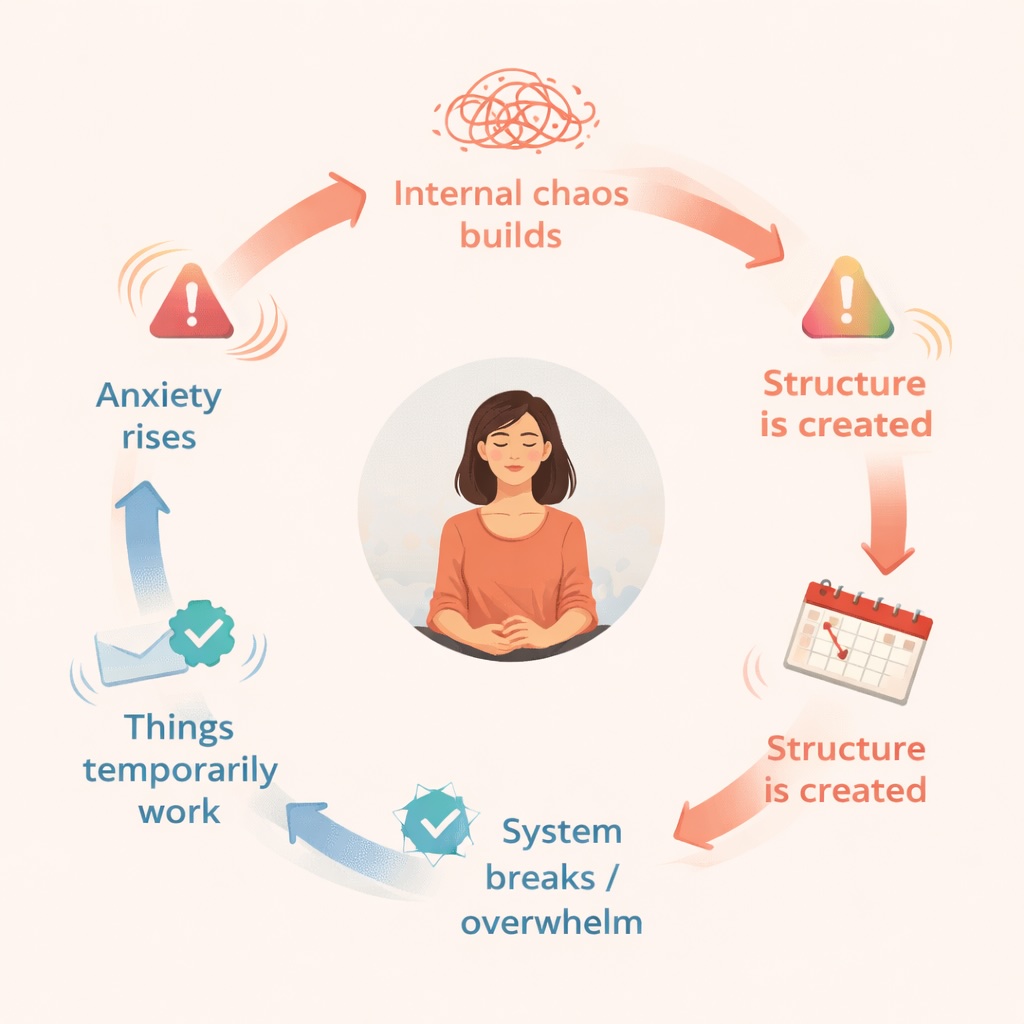
The Compensation Loop
1. Things start to feel chaotic internally
2. Anxiety rises (“I need to get on top of this”)
3. You create structure – lists, plans, systems
4. For a while, everything works
5. Then something slips (because ADHD is still there)
6. You feel like you’ve failed
7. You rebuild the system – often even more strictly
Repeat. Quietly. Efficiently. Invisibly.
From the outside, it looks like you’re organised.
From the inside, it feels like you’re constantly catching things before they fall.
This is why so many AuDHD women are described as “high functioning.”
But here’s the truth:
Competence is often compensation, not capacity.
You’re Not Just Masking – You’re Managing Perception
We often talk about masking in neurodiversity – but in AuDHD women, it tends to be more layered.
You’re not just hiding traits. You’re managing how your competence is perceived.
You double-check everything before sending it
You prepare more than necessary
You avoid showing confusion or overwhelm
You push through when you probably shouldn’t
Not because you’re trying to be perfect. But because you’ve learned – often without realising it – that being seen as unreliable has consequences.
So you create a version of yourself that is:
dependable
organised
capable
And you protect that version carefully.
Even if maintaining it is exhausting.
The Invisible Exhaustion No One Sees
This is the part that rarely gets talked about properly.
Not the burnout that leads to collapse.
But the daily exhaustion of holding everything together.
It looks like:
making dozens of micro-adjustments just to stay on track
mentally rehearsing conversations before and after they happen
feeling unable to fully relax (“If I switch off, everything will fall apart”)
needing more recovery time than your life realistically allows
And often:
You don’t fall apart in front of people.
You fall apart afterwards.
Behind closed doors. In the quiet moments. When there’s finally no one to perform for.
“But You’re Doing So Well…”
This is where things get complicated. Because from the outside – you are doing well.
You’re working. You’re managing responsibilities. You’re functioning.
So when you say you’re struggling, the response is often:
“But you seem fine.”
And that’s when something shifts internally.
You start to question yourself.
“Maybe I’m exaggerating.”
“Other people have it worse.”
“If I can do all this, why does it feel so hard?”
This is how shame forms.
Not from failure.
But from the mismatch between how things look and how they feel.
If I’m Coping… Why Does It Feel Like I’m Not?
This is one of the most disorienting parts of AuDHD.
You are coping. But it doesn’t feel sustainable. It doesn’t feel natural. And it definitely doesn’t feel easy.
So where does that leave you?
Often in a strange in-between space:
Not fully identifying with ADHD content (“I’m not that chaotic”)
Not fully identifying with autism content (“I’m not that rigid”)
Not feeling like you fit anywhere
Just… managing.
But not understanding why it takes so much effort.
What If “Functioning” Is the Wrong Measure?
We use words like functioning as if they tell us everything we need to know.
But they don’t.
Because functioning only answers one question:
Can you do it?
It doesn’t answer the more important one:
What does it cost you to keep doing it?
Does it drain you completely?
Does it leave no space for anything else?
Does it rely on constant self-monitoring and pressure?
If the answer is yes, then what you’re experiencing isn’t “fine.”
It’s unsustainable competence.
Working With Your Brain – Not Against the Illusion
So what helps?
Not more discipline. Not better planners. Not trying harder to “be consistent.”
What helps is understanding what’s actually happening and adjusting accordingly.
1. Separate capacity from performance
Just because you can do something doesn’t mean you can do it consistently, sustainably, or without cost.
2. Identify what is propped up vs what is natural
Which parts of your life flow and which are being held together through effort alone?
3. Build flexible structure (not rigid systems)
Rigid systems break under ADHD pressure. Flexible systems bend and survive.
4. Allow visible imperfection
You don’t have to look “together” all the time to be capable.
In fact, letting some of that image soften can reduce the pressure to maintain it.
You Were Never “Just About Coping”
If you’ve recognised yourself in this article, there’s something important to understand.
You’re not inconsistent.
You’re not failing.
You’re not “almost managing.”
You’ve been doing something far more complex than that.
You’ve been:
adapting
compensating
building systems
holding things together in ways that aren’t visible from the outside
Of course you’re tired. Of course it feels hard. Of course it doesn’t match how it looks.
Because this was never simple.
You don’t need to become more organised.
You need a way of living that doesn’t rely on holding everything together all the time.
And that starts with understanding that what you’ve been experiencing has a name.
Even if no one gave it to you before.
For a deeper, first-hand insight into how AuDHD actually feels, I highly recommend listening to Dr. Samantha Hiew on the ADHD Chatter podcast, where she articulates the experience with remarkable clarity and nuance.