

Your teenager can spend an hour telling you about a game, a YouTube video, something ridiculous a teacher said, or a complicated disagreement between six people in their friendship group.
Then they come home looking visibly upset.
“What happened?”
“Nothing.”
“You don’t look fine.”
“I don’t know.”
“Did something happen at school?”
“No.”
“Was it your friends?”
“I said I don’t know.”
A few more questions and suddenly they are angry. They disappear into their room, slam the door, put their headphones on and perhaps half an hour later you hear them talking perfectly normally to a friend.
For a parent, the conclusion can feel obvious.
They can talk. They just don’t want to talk to me.
Sometimes, of course, teenagers don’t want to talk to their parents. That is part of being a teenager. Privacy matters, and ADHD shouldn’t be used to explain every adolescent behaviour.
But there is another possibility that is often missed.
Being highly verbal is not the same as being able to identify, retrieve and organise your internal experience, particularly when you are distressed.
And sometimes, when an ADHD teenager says, “I don’t know”, they genuinely don’t know. Or, more precisely, they don’t know yet.
Talking is not the same cognitive task as explaining yourself
We tend to think of communication as a single ability. Someone is either “good at talking” or they aren’t.
But compare two situations.
Ask a teenager about their favourite game, a musician they love or the unfair thing that happened in science yesterday, and the conversation already has a structure. There is something concrete to retrieve. One thought prompts another. The subject itself provides hooks that pull the conversation forward.
Now ask:
“What’s wrong?”
It sounds like a simple question. It isn’t.
To answer it, a teenager may need to notice what is happening internally, identify which feeling or sensation matters, work out what triggered it, retrieve relevant events, separate what happened today from everything that has been building for the past week, decide what it means, organise all of that into some kind of sequence, find the language for it and then decide how much of it feels safe to tell you.
They may also be trying to predict what will happen once they answer.
Will you worry? Give advice? Ask more questions? Tell the school? Say they are overreacting? Try to fix something they don’t want fixed?
That is a surprisingly complicated piece of mental work.
And they are being asked to do it at precisely the moment when their cognitive and emotional resources may already be stretched.
Conversation often comes with scaffolding.
Introspection often doesn’t.
“What’s wrong?” can contain ten different questions
Adults usually know what we mean when we ask, “What’s wrong?”
The teenager has to work out what we mean.
Are you asking what happened? How I feel? Why I feel it? Who caused it? Whether something happened at school? Whether you need to do something? Whether I’m angry with you?
And what if the honest answer isn’t one thing?
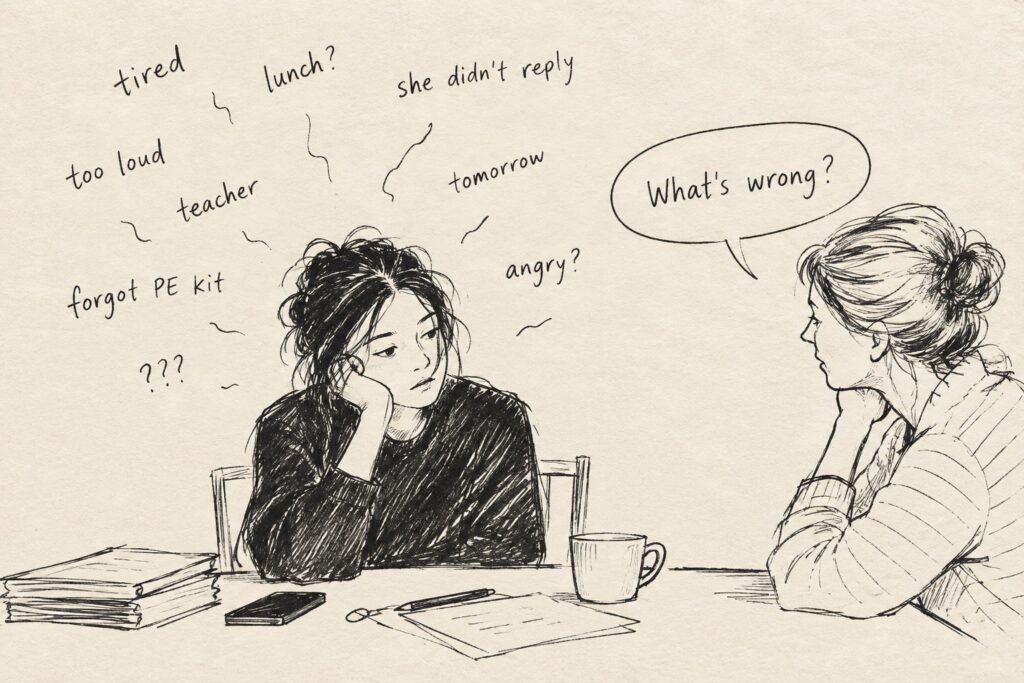
Perhaps a friend ignored them at lunch. They don’t know whether it was deliberate. They then forgot their PE kit, were told off by a teacher, realised they hadn’t eaten properly, spent the afternoon trying not to cry, came home exhausted and then couldn’t find their headphones.
Now you ask what is wrong.
Which answer should they give you?
“The headphones” sounds ridiculous.
“The teacher” isn’t really it.
“The friend” might be it, but they aren’t sure anything actually happened.
“Everything” will probably lead to more questions.
So: “I don’t know.”
We often interpret this as a failure to cooperate when it may be a fairly accurate description of their current access to the information.
Sometimes the body knows before the teenager does
One of the things I find particularly important when thinking about ADHD is that awareness doesn’t always arrive in the order adults expect.
We imagine something happens, the teenager recognises how they feel about it, and then they behave accordingly.
Real life can look very different.
A teenager may know:
I need everyone to stop talking to me. Before they know: I have spent seven hours concentrating, filtering noise, navigating friendships, trying not to forget things, being corrected, feeling hungry without noticing I was hungry, and holding myself together.
The body and behaviour may signal distress before the teenager has a coherent explanation for it.
This is where interoception – our perception of signals coming from within the body, can be relevant. Some people with ADHD report difficulty noticing or interpreting internal signals until they become difficult to ignore. Emotional identification can also be complicated by overlapping sensations: tension, agitation, fatigue, hunger, sensory overload and anxiety can become one large, uncomfortable feeling of something being wrong.
That does not mean every teenager with ADHD has poor interoception or difficulty identifying emotions. ADHD is far too variable for that.
But it does mean we should be careful about assuming that because we can see a teenager is upset, they must already understand why.
Sometimes behaviour is the first available language for an experience that hasn’t yet become a story.
There may not be one feeling to identify
A lot of advice about emotional literacy focuses on helping young people name emotions. That can be useful, but sometimes the problem isn’t lack of vocabulary.
The problem is that the emotional experience is messy.
A teenager might be embarrassed about something they said, angry with a friend, worried that the friend is angry with them, ashamed that they care so much, exhausted from school and furious with themselves for losing something.
Then an adult asks:
“Are you anxious?”
“No.”
“Are you angry?”
“No.”
“Are you upset about your friend?”
“I DON’T KNOW.”
We may be trying to put a label on something that hasn’t separated into neat categories yet.
The task isn’t always naming the feeling. Sometimes it is untangling the experience. And untangling takes time.
Why more questions can produce less information
This is where conversations between parents and teenagers can go wrong very quickly.
The parent notices something is wrong and becomes concerned.
Concern creates urgency.
Urgency produces questions.
The teenager can’t answer.
The parent’s concern increases, so the questions become more specific.
“Did somebody say something?”
“Did you get a bad grade?”
“Is this about Ella?”
“Has something happened online?”
“Are you worried about tomorrow?”
From the parent’s perspective, this is help. You are offering possibilities because your child appears unable to explain.
From the teenager’s perspective, however, another thing may be happening.
They are now trying to understand their own internal state while simultaneously processing your questions, rejecting incorrect possibilities, monitoring your tone, watching your reaction and feeling increasing pressure to produce an answer.
The conversation itself has become another cognitive demand.
And as pressure increases, access to language and organised thinking may become worse rather than better.
Eventually the teenager shouts:
“JUST LEAVE ME ALONE.”
The parent concludes that communication has broken down.
But perhaps communication became impossible partly because we were trying so hard to make it happen.
“I don’t know” doesn’t always mean the same thing
One of the most useful changes parents can make is to stop treating “I don’t know” as a single response.
It can mean:
I haven’t worked it out yet.
Or:
There are too many things and I can’t tell which one matters.
It might mean:
I know what happened but I don’t understand why it affected me this much.
Or:
I know, but I’m embarrassed to tell you.
Sometimes it means:
If I tell you, you’ll try to solve it and I don’t want you to.
And sometimes it simply means:
I genuinely don’t know.
That last possibility is important.
We shouldn’t turn “I don’t know” into another thing adults insist on decoding. Teenagers are entitled to privacy, uncertainty and experiences they don’t immediately understand.
The useful question isn’t always, What does “I don’t know” really mean?
Sometimes it is:
What does this teenager need while they don’t know?
The problem may partly be the audience
Parents can understandably feel hurt when their teenager refuses to talk to them and then spends two hours talking to a friend.
But those two conversations are not equivalent.
Talking to a parent can carry consequences.
A friend probably isn’t going to email the head of year. They aren’t going to book an appointment, suggest a new strategy, remind you what happened last time, worry visibly or ask whether you have finished your homework.
Even a kind, supportive parent represents something different from a friend.
And some neurodivergent teenagers have accumulated years of experiences of being corrected, questioned or misunderstood.
“Why did you do that?”
“How did you forget again?”
“Why didn’t you just start earlier?”
“You know you can do this.”
“You need to try harder.”
By adolescence, being asked to explain themselves can already feel loaded.
This is why psychological safety matters as much as emotional vocabulary.
A teenager may have the words but not feel ready to use them with you.
Stop demanding the finished story
There is a different way to approach these moments.
Instead of thinking, How do I get them to tell me what’s wrong?, try:
How do I make it easier for them to work out what’s wrong?
That is a very different job.
It may mean saying:
“Do you know what’s bothering you yet?”
Or:
“Is this mostly school, people, or just everything?”
You can also ask:
“Do you want me to listen, help you work it out, or leave it for now?”
Sometimes the most useful sentence is simply:
“You don’t have to explain it now.”
And occasionally what a teenager needs is something even simpler:
“Do you want company while you don’t know?”
Notice what these responses remove. The teenager no longer has to produce a coherent explanation in order to deserve support.
That can make an enormous difference.
Serious conversations don’t always need to look serious
There is another assumption worth questioning: that important emotional conversations require two people sitting opposite each other, making eye contact and concentrating entirely on the conversation.
For some teenagers, that is almost the worst possible environment.
Some talk more easily in the car, while walking the dog, cooking, drawing, gaming or doing something else with their hands. Looking in the same direction rather than directly at each other can reduce the sense of being examined.
Timing matters too.
The conversation a teenager cannot have at 4.15pm after school may suddenly become possible at 10.30pm.
And speaking isn’t necessarily the best channel.
Some teenagers can send a text from upstairs explaining something they could not possibly say sitting across the kitchen table.
Adults sometimes worry that allowing this avoids “proper communication”.
I see it differently.
The goal is not to teach a teenager to communicate in the form adults happen to prefer.
The goal is to discover the conditions in which thinking and communication become possible.
The longer-term goal is not getting better answers
There is a much bigger developmental opportunity here. Ultimately, we don’t want parents to become increasingly skilled at extracting information from teenagers.
We want teenagers to become increasingly skilled observers of themselves.
That means gradually noticing patterns. What does overload feel like before it becomes an explosion? What happens in their body when they haven’t eaten? Which social situations leave them depleted? What is the difference between anger and embarrassment for them? When do they need solitude and when do they actually need connection? How long does it usually take before an experience makes sense? What makes talking easier?
And perhaps most importantly, what can they say when they don’t yet have an answer?
“I need some time.”
“I know I’m upset but I don’t know why.”
“Something happened, but I don’t want advice yet.”
“I’ll tell you later.”
Those are significant self-advocacy skills.
In my work with teenagers and parents, some of the most useful conversations are not about getting a young person to communicate more. They are about discovering the conditions under which communication becomes possible in the first place.
Sometimes that work happens with the teenager: developing awareness, language, confidence and ways of understanding their own patterns.
Sometimes the most useful work happens with the parent: learning when to ask, when to wait, when to help organise an experience and when not to turn distress into a problem-solving exercise.
Often both sides are learning something.
Don’t confuse performance with capacity
Perhaps this is the bigger lesson.
The teenager who talks constantly isn’t necessarily able to explain distress. The teenager who succeeds academically isn’t necessarily finding school manageable. The socially confident teenager isn’t necessarily socially comfortable. The teenager who holds everything together at school may have very little left when they get home. And the teenager who explained their feelings brilliantly yesterday may genuinely struggle to access them today.
We make mistakes when we judge neurodivergent young people only by what we have seen them do before.
Capacity is affected by context, stress, fatigue, interest, safety, cognitive load and the demands of the moment.
So the next time an articulate teenager looks miserable and responds to “What’s wrong?” with an infuriating “I don’t know”, it may be worth resisting the next question.
They may not be refusing to communicate. They may simply not have the answer in a form they can give you yet.
And that small word – yet – changes something important.
The parent’s job is no longer to extract the explanation.
It is to help create the conditions in which one can eventually emerge.