

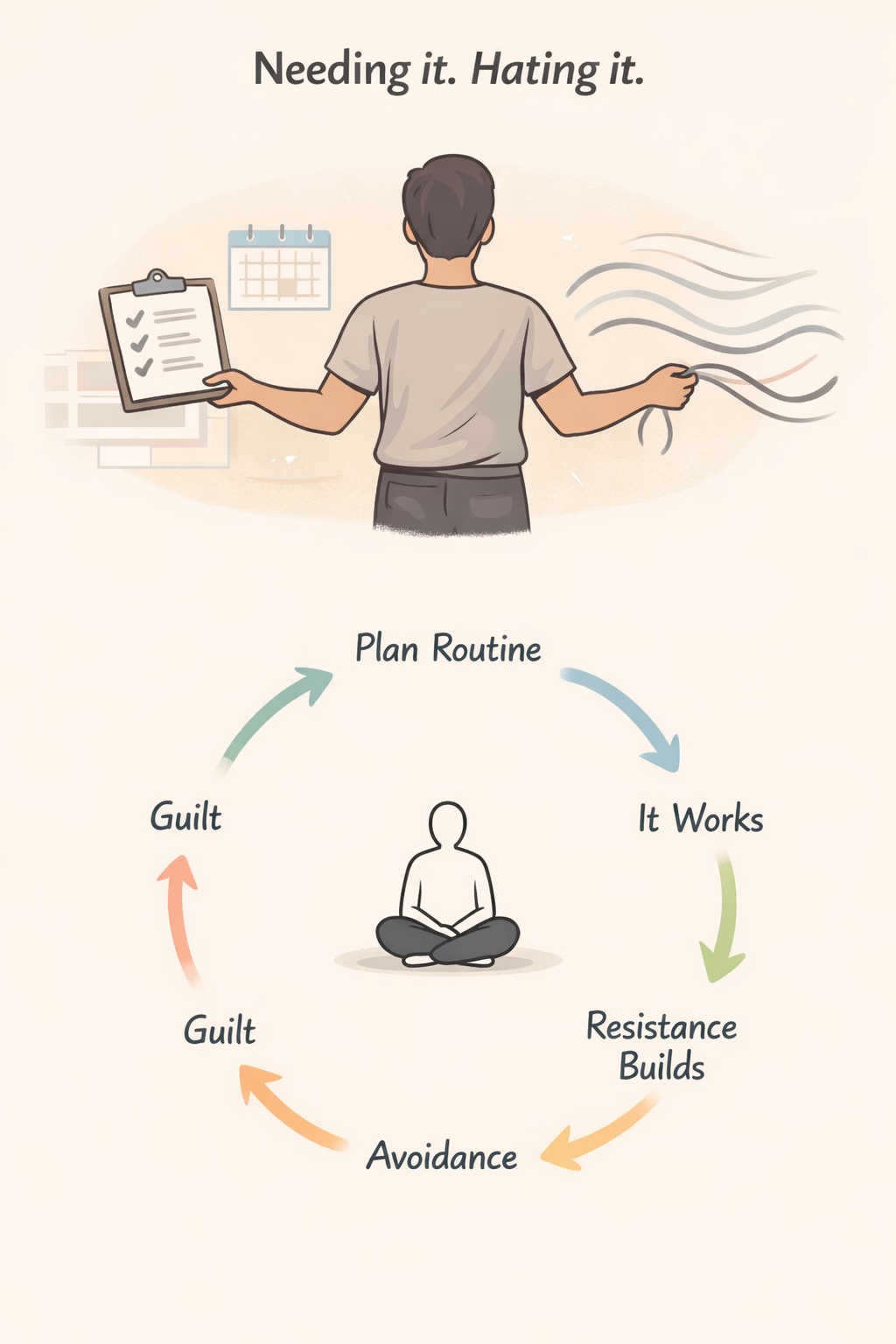
You sit down and finally create a routine that makes sense.
It’s realistic.
It’s structured.
It even feels… calming.
“This is it,” you think.
“This is the one that will actually work.”
For a few days, it does.
You wake up with a bit more clarity.
Things feel contained.
There’s a sense of control.
And then, quietly, something shifts.
You start resisting it.
You delay parts of it.
You feel an odd tension when you look at your own carefully planned schedule.
By the end of the week, you’re avoiding it altogether.
Not because it was a bad routine.
Not because you didn’t want it.
But because something in you stopped cooperating.
If this pattern feels familiar, you’re not lacking discipline.
You’re experiencing one of the most confusing and least understood aspects of AuDHD:
needing routine and resisting it at the same time.
Wanting Structure. Resisting Structure.
Most advice about routines assumes a simple problem: you either have structure, or you don’t.
But for people with AuDHD, the issue is not the absence of structure.
It’s the presence of two equally strong needs that don’t naturally align.
Part of you genuinely wants routine.
Not in a vague, aspirational way – but in a very real, almost physical sense.
Structure reduces noise. Predictability lowers anxiety. Knowing what comes next can feel like relief.
And yet, at the same time, another part of you pushes back.
It resists repetition. It gets bored quickly. It avoids anything that feels imposed – even if you were the one who imposed it.
So you end up in a strange position:
You don’t lack routine. You lack a routine your brain consistently agrees with.
Why Your Brain Both Needs and Rejects Routine
To understand this conflict, you have to look at what’s happening underneath the surface.
The autistic side of the brain tends to seek stability. It prefers patterns, predictability, and environments that are structured enough to feel manageable. Routine, in this context, is not just helpful – it’s regulating. It reduces uncertainty and creates a sense of safety.
At the same time, the ADHD side of the brain operates very differently. It is driven by interest, novelty, and stimulation. Repetition can feel draining rather than comforting. Tasks that are predictable can quickly become invisible or aversive, not because they are difficult, but because they are no longer engaging.
When these two systems coexist, routine becomes complicated.
The same structure that calms one part of your brain can feel restrictive to another. The same repetition that creates stability can also trigger resistance.
So when you find yourself both craving routine and pushing against it, this isn’t inconsistency.
It’s a perfectly logical response to a very real internal conflict.
The Rise and Fall of Every “Perfect Routine”
There is often a predictable rhythm to this experience.
You design a routine that feels thoughtful and aligned. It reflects what you need. It is realistic enough to seem sustainable. For a short time, it works. There is a sense of momentum, even a quiet satisfaction in finally “getting it right.”
Then, gradually, friction appears.
It might show up as subtle avoidance. A small delay. A growing reluctance to follow something that previously felt helpful. The routine hasn’t changed – but your relationship to it has.
At this point, many people assume they need more discipline, more motivation, or a better system.
But what is actually happening is simpler and more uncomfortable.
The routine is no longer stimulating enough for the ADHD side of the brain, and no longer flexible enough to accommodate that shift.
So the system begins to break.
When it does, the emotional response is often immediate. Frustration. Guilt. A sense of failure.
“Why can’t I just stick to something?” So you try again.
You refine the routine. Improve it. Simplify it. Optimise it.
And for a while, it works again.
Until it doesn’t.
The problem is not that routines don’t work.
It’s that they don’t stay workable in the same form.
Why This Feels So Personal
This pattern doesn’t just affect productivity. It affects how people see themselves.
Because routine is often framed as a basic life skill, struggling with it can feel like a personal flaw rather than a neurological reality.
You might find yourself thinking:
“I know what to do. So why don’t I do it?”
“Other people manage routines. Why can’t I?”
“Maybe I’m just not trying hard enough.”
Over time, this becomes less about routines and more about identity.
You stop trusting your own systems. You start questioning your own intentions. You feel inconsistent – even when you’re putting in significant effort.
And perhaps most confusing of all – part of you still wants routine.
Which makes the resistance feel even harder to understand.
Safety vs Freedom: The Real Conflict
At a deeper level, this is not just about routine.
It’s about two different needs that are both valid – and often in tension.
Routine offers safety. It reduces decision-making. It creates a sense of control in a world that can otherwise feel unpredictable.
But routine can also feel restrictive. It removes spontaneity. It limits flexibility.
It can feel like something you have to follow, rather than something that supports you.
So you’re not choosing between right and wrong. You’re choosing between two different kinds of discomfort.
Too much structure, and you feel trapped.
Too little structure, and you feel overwhelmed.
The difficulty is not in choosing one. It’s in trying to live somewhere in between.
Why “Just Stick to a Routine” Doesn’t Work
Most mainstream advice about routines is built on the assumption that consistency is the goal.
Build habits.
Repeat daily.
Stay disciplined.
But this advice doesn’t account for internal conflict. It assumes that once a routine is designed, the main challenge is sticking to it.
For AuDHD, the challenge is different.
It’s not about commitment. It’s about sustainability.
A routine can be perfectly designed and still fail – not because it’s ineffective, but because it doesn’t adapt to how your brain actually functions over time.
So when advice tells you to “just stick to it,” it misses the point.
If discipline alone were the answer, you would have solved this already.
Working With the Conflict, Not Against It
What tends to help is not forcing routine, but rethinking what routine is allowed to be.
Instead of rigid schedules that demand consistency, it becomes more useful to think in terms of flexible structure. Something that provides guidance without requiring perfect repetition.
This might mean keeping the shape of a routine, but allowing variation within it. The same morning structure, for example, but with different ways of engaging with it depending on energy and interest.
It also helps to reduce the scale of what you expect from yourself. A routine that is technically “ideal” but difficult to sustain is less useful than one that is simple enough to return to, even after disruption.
Another shift is moving from control to negotiation.
Instead of forcing yourself to follow a plan exactly, you begin to ask:
“What would make this easier to start today?”
“What version of this feels possible right now?”
This is not lowering standards. It is recognising that cooperation works better than force.
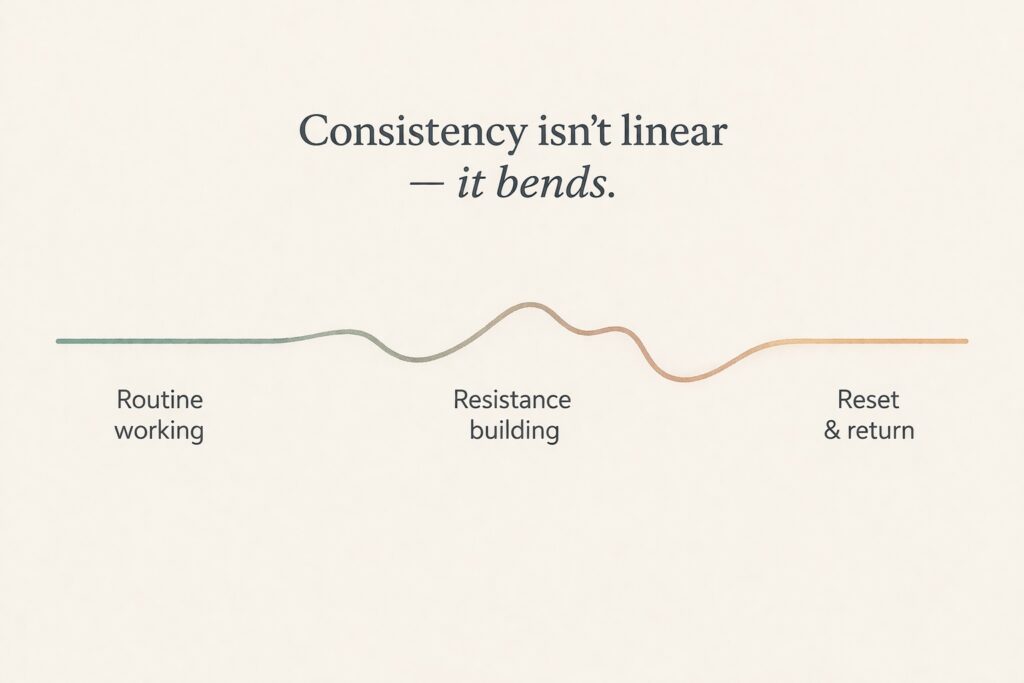
And perhaps most importantly, it helps to accept that cycles are part of the process.
Consistency, in the traditional sense, may not be realistic. But continuity – returning, adjusting, rebuilding – often is.
You’re Not Failing at Routine
If you’ve spent years trying to “fix” your relationship with routine, it’s worth pausing to consider a different perspective.
You’re not failing at routine. You’re trying to apply a model of consistency that doesn’t fully account for how your brain works.
The goal is not to find a perfect routine and follow it indefinitely. The goal is to create systems that can change with you without collapsing entirely.
That is a much more complex skill.
And if you’ve been attempting it – even imperfectly – you’ve likely been doing far more than you’ve given yourself credit for.
A Different Way Forward
You don’t need to force yourself into a routine that you constantly resist.
You need a way of structuring your life that allows for both stability and movement.
That means:
- structure that supports you, not controls you
- flexibility that doesn’t turn into chaos
- expectations that reflect reality, not ideal scenarios
This is not about lowering the bar.
It’s about setting one that your brain can actually reach – consistently enough to matter.
At the centre of all of this is a simple but important realisation:
You were never the problem.
The expectation of perfect consistency was.
And once that shifts, routine stops being a battleground and starts becoming something you can actually work with.
Dana Dzamic
Neurodiversity consultant and ADHD coach
Founder of ADHD Insight Hub
Read more from London Psychiatry Clinic: AuDHD Explained: When Autism & ADHD Overlap