

Why knowing is not the same as being able to act – especially for people with ADHD and other forms of neurodivergence
You know what to do. That is the frustrating part. If you have ADHD, knowing what to do but not doing it can become one of the most confusing and distressing parts of everyday life. You know the email needs answering.You know the appointment needs booking. You know the form will take approximately seven minutes once you actually open it. You know staying up until 1 a.m. will make tomorrow harder. You know the pile of clothes on the chair is no longer a pile of clothes. It has become a semi-permanent installation.
You may even have a detailed plan. Perhaps you wrote the plan in a notebook, transferred it to an app, colour-coded it and then watched several videos about how to improve the system.
And yet, the task remains undone. You think about it while making coffee. You remember it in the shower. It appears in your mind just as you are falling asleep. It follows you through the day like a tiny, unpaid debt collector:
Hello. Just checking whether you have replied to that email yet.
You have not forgotten. You do care. You are not confused about what needs to happen.
So why can’t you do it?
For many people with ADHD, autism, AuDHD and other neurodivergent profiles, this is one of the most painful and misunderstood parts of everyday life. It is difficult enough to experience the gap between intention and action. It is even harder when everyone around you assumes that the gap should not exist.
“You know what you need to do.”
“We’ve already talked about this.”
“You’ve had plenty of time.”
“Why do I have to keep reminding you?”
“Just get it over with.”
After hearing these messages repeatedly, many people reach a conclusion that feels logical but is often deeply inaccurate:
There must be something wrong with me.
Perhaps I am lazy.
Perhaps I am careless.
Perhaps I am undisciplined.
Perhaps I simply do not want it enough.
But what if knowledge was never the problem? What if the mistake is believing that knowing what to do should automatically make doing it possible?
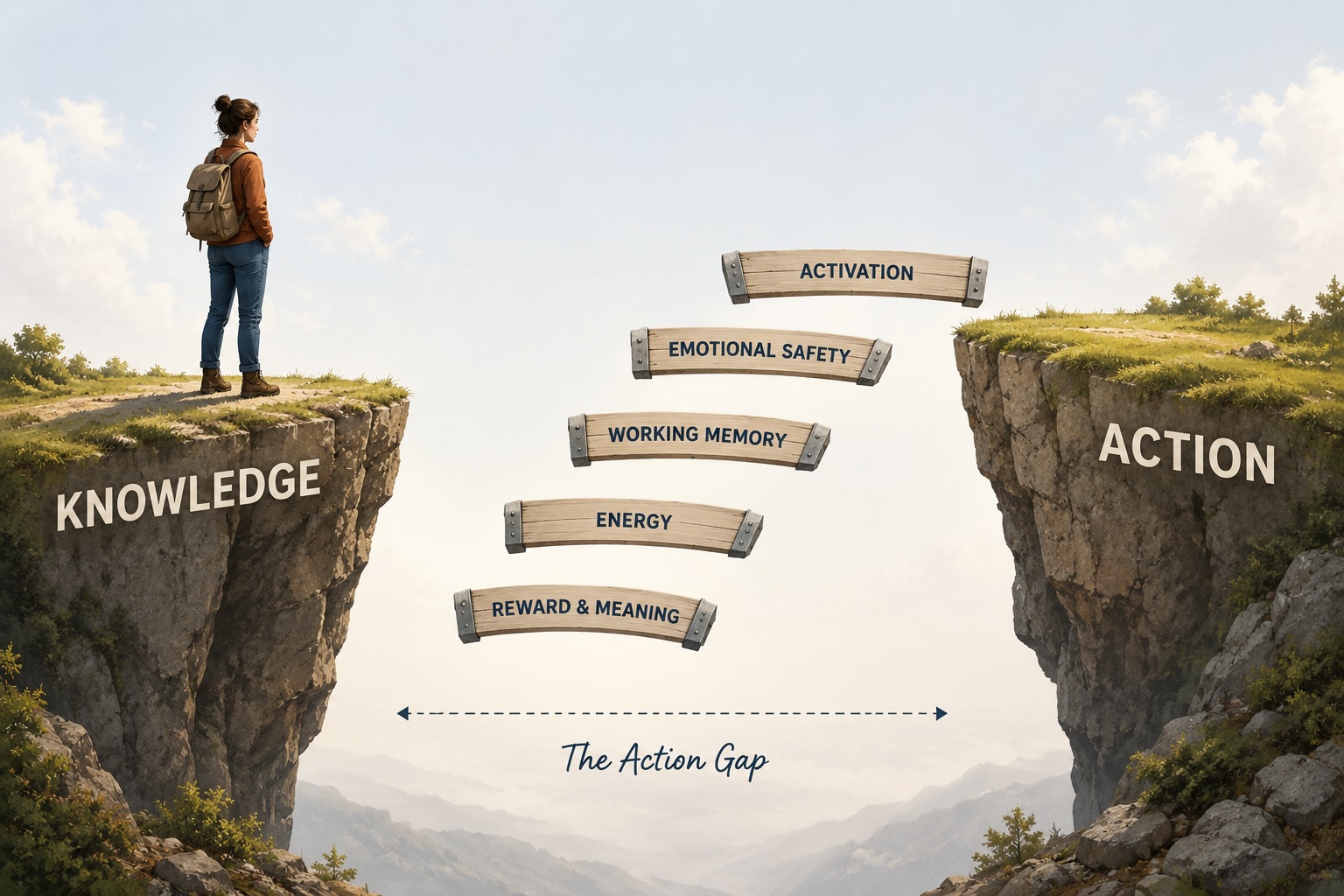
The Action Gap
There is often a distance between knowing and doing.
We might call it the Action Gap.
The Action Gap is the space between:
“I understand what needs to happen”
and
“I am able to begin, continue and complete it.”
For some people, that gap is relatively small.
For others, particularly many neurodivergent people, it can feel enormous.
You may be able to see the task clearly on the other side. You may know every step required to reach it. You may genuinely intend to move.
But intention does not always build the bridge.
This gap can appear in obvious situations:
- starting a report;
- revising for an exam;
- cleaning the kitchen;
- completing paperwork;
- applying for a job;
- replying to messages.
But it also appears in more personal areas of life:
- going to bed when you are tired;
- leaving a relationship you know is harmful;
- eating before you become completely depleted;
- asking for help;
- setting a boundary;
- resting before you reach burnout.
People often interpret the Action Gap as a failure of willpower.
In reality, action is far more complex than that.
The Model Most of Us Were Taught
Most of us grow up with a very simple model of behaviour.
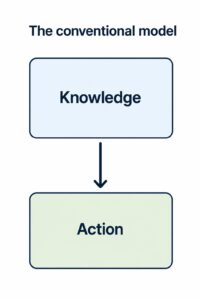
The assumption is that once a person understands what they should do, action should naturally follow.
This model shapes how we respond when someone is struggling. Parents explain again. Teachers repeat the instructions. Managers send another reminder. Partners point out that the conversation has already happened. Professionals offer more advice.
We assume that more information will produce more action.
Sometimes it does. But sometimes it is like giving someone a better map when the bridge is missing. They already know where they need to go. The difficulty is getting there.
Action Is an Orchestra, Not a Light Switch
A more accurate model is to think of action as an orchestra. Knowledge is the sheet music. The instructions are there. The sequence is clear. But sheet music does not create a performance.
You also need musicians who are ready to play. You need a conductor. You need timing, coordination, attention and energy. The musicians need to hear one another. They need to enter at the right moment. And if the percussion section is still looking for the building, the symphony may not begin on time.
Action works in a similar way.
Knowing what to do is only one part of a much larger process. To turn intention into action, several systems need to cooperate. When one or more of those systems become unavailable, the Action Gap widens.
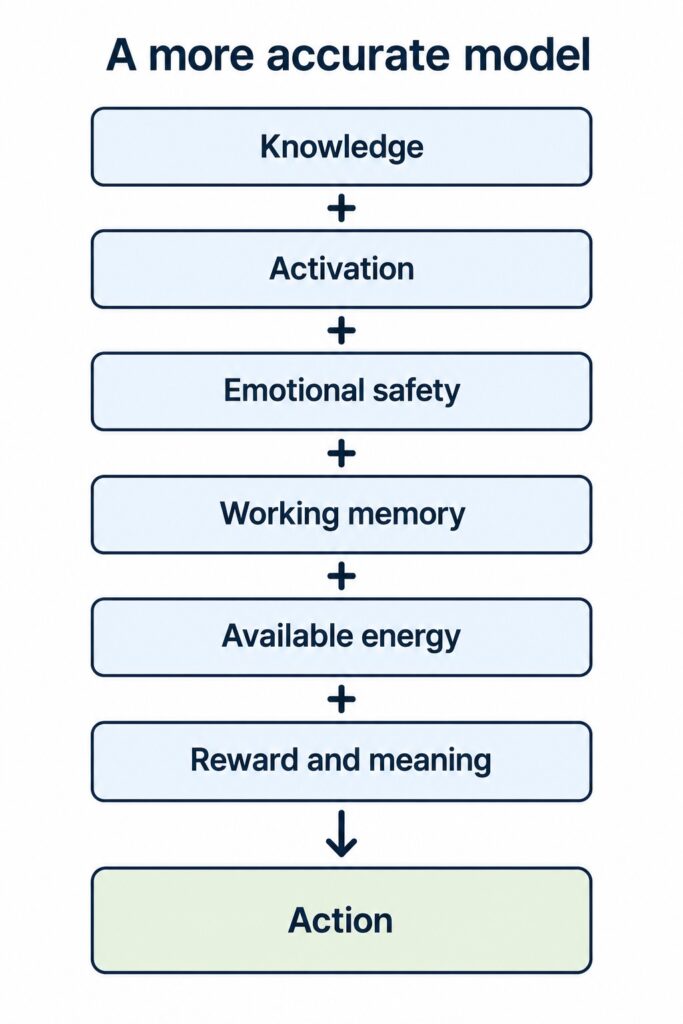
The important point is not that every task requires all these systems in exactly the same way. It is that action is produced by an interaction between them.
That is why you may complete a difficult task one day and feel unable to begin a simple one the next. The task is not the only variable. Your internal system has changed too.
The Six Systems That Turn Knowing Into Doing
1. Knowledge: Do I Understand the Task?
This is the system most people focus on. Do you know what needs to happen? Do you understand the instructions? Do you have the necessary information?
Sometimes this genuinely is the problem. A vague request such as “sort out the project” may be too unclear to act on. A child may not know what “tidy your room” actually means. An employee may understand the final outcome but not the sequence required to reach it.
However, many adults with ADHD already know exactly what to do. In fact, they often know far more than they need to. They have read the books. They have listened to the podcasts. They have downloaded the apps. They have saved 43 posts about morning routines. They own multiple planners, including one so beautiful that using it now feels like an act of vandalism.
The problem is not a lack of insight. The problem is that insight has not turned into action. More advice may therefore create an unexpected emotional effect. Instead of helping, it can increase shame. Every new strategy becomes another thing the person understands but cannot consistently implement.
The result is not:
“Excellent, now I know what to do.”
It is:
“I already knew that. Why am I still not doing it?”
2. Activation: Can My Brain Shift Into Action?
Starting is often described as though it is a simple choice.
You decide to begin.
Then you begin.
But for many people with ADHD, the transition from intention to action is unreliable. You may sincerely want to start. You may be worried about not starting. You may be sitting directly in front of the task.
You may even be saying, out loud: “I am going to start now.”
And still nothing happens.
This is not necessarily defiance, indifference or laziness. It may be an activation difficulty. The brain has not yet shifted from knowing into doing.
And yet, many people spend years trying to activate themselves through criticism:
“Come on.”
“This is ridiculous.”
“Why are you like this?”
“Normal people can do this.”
Sometimes urgency eventually provides enough stimulation to start the engine. This is why a person may struggle for three weeks and then complete the task in a frantic burst the night before the deadline.
From the outside, this can look like proof that they were capable all along. But being able to act under emergency conditions is not the same as having reliable access to activation.
3. Emotional Safety: What Does This Task Mean to Me?
Some tasks are difficult because they are complicated. Others are difficult because they are emotionally loaded.
Sending an email may technically require three sentences.
But emotionally, it may contain:
- fear of criticism;
- uncertainty about tone;
- guilt about replying late;
- worry about being misunderstood;
- fear of disappointing someone;
- perfectionism;
- anticipated rejection.
The physical task is small. The emotional task is enormous.
This is one reason traditional productivity advice can fail.
“Just send it” addresses the visible action. It does not address the threat attached to it.
For a person with a history of criticism, rejection, misunderstanding or making mistakes, a simple task may activate a much larger internal story. The nervous system does not respond only to what is happening now. It also responds to what the task predicts.
What if I get it wrong?
What if they are annoyed?
What if I cannot explain myself properly?
What if this proves I am incompetent?
From the outside, the person appears to be avoiding an email. Inside, they may be avoiding shame.
4. Working Memory: Can I Hold the Task Together?
Working memory is the brain’s ability to hold and use information temporarily. It allows you to remember what you are doing while you are doing it. This sounds straightforward until you try to complete a multi-step task while your attention is being pulled in several directions.
Imagine carrying six shopping bags. Now imagine someone quietly removing one every few seconds and leaving it somewhere behind you. You know you started with six. You are fairly sure something is missing. But you cannot remember which bag it was or where you left it.
A task such as “book the appointment” may actually contain multiple steps:
- Find the referral letter.
- Locate the phone number.
- Check your calendar.
- Call during opening hours.
- Listen to the menu options.
- Remember what you need to ask.
- Record the appointment.
- Arrange transport or childcare.
If working memory becomes overloaded, the task may repeatedly fall apart. The person begins. Gets interrupted. Loses the thread. Returns later. Cannot remember where they stopped. Starts again.
This is exhausting.
It also explains why someone can appear highly capable in one environment and disorganised in another. The difference may not be intelligence. It may be how much information the environment requires them to hold internally.
The accidental task migration
You begin by paying a bill.
While looking for the account number, you notice an unread message.
The message reminds you to check the calendar.
The calendar reveals that someone has a birthday tomorrow. You search for a present.
While searching, you notice that you still have a browser tab open about air fryers.
Forty minutes later, you know a surprising amount about dual-drawer cooking technology.
The bill remains unpaid.
This can look absurd from the outside.
It often feels absurd from the inside too.
But it is not evidence that the person does not care about the bill.
The task was lost during transit.
5. Available Energy: Does My Brain Have the Resources?
A person can know what to do, care deeply and still lack the cognitive energy required to act.
This is particularly important for neurodivergent people because much of their energy use may be invisible.
A day may include:
- filtering sensory information;
- monitoring facial expressions;
- adjusting tone of voice;
- remembering social rules;
- suppressing movement;
- coping with interruptions;
- switching repeatedly between tasks;
- managing emotional reactions;
- decoding vague expectations;
- trying not to appear overwhelmed.
This is often described as masking, self-monitoring or compensation. It can consume enormous amounts of mental energy. By the time the person arrives home, the visible demands may have ended. But the internal resources have also run out.
Someone may then ask:
“Why can’t you just put the dishes away?”
Because the dishes are not arriving in an empty brain. They are arriving after ten hours of orchestral performance. The musicians are tired. The conductor has left. Someone is asleep beside the cello. Energy also affects inconsistency. A person may complete a task easily one morning and feel unable to approach it the next evening.
This often causes confusion in families and workplaces.
“You did it yesterday.”
Yes.
But yesterday’s available energy is not stored in a savings account.
It cannot always be withdrawn today.
6. Reward and Meaning: Does My Brain Expect This to Feel Worthwhile?
The brain is constantly estimating whether effort is worth the expected reward. Some tasks offer an immediate payoff. A funny message. An interesting conversation. A new idea. A problem that feels urgent or challenging.
Other tasks offer rewards that are distant, abstract or emotionally flat. Updating insurance details. Submitting expenses. Renewing a passport. Organising digital files.
These tasks may be important. But importance and motivational pull are not the same thing.
Many people with ADHD find it easier to activate when a task contains:
- interest;
- novelty;
- urgency;
- challenge;
- emotional meaning;
- immediate feedback.
This does not mean they are only willing to do enjoyable things. It means the nervous system may struggle to mobilise for tasks whose reward feels remote.
You care that your passport expires. You also cared six months ago. Apparently not in a way that generated action. Now the flight is in nine days, and suddenly the passport has become the most fascinating object in your life. Again, urgency has stepped in as conductor.
The Systems Do Not Work Separately
The six systems are useful to examine individually. In real life, however, they overlap. A task may involve activation difficulties, emotional threat and low energy at the same time.
Consider someone who has delayed replying to a friend. At first, the delay may be caused by distraction. Then guilt appears. The person now feels they need to write a particularly thoughtful response to compensate. The message becomes emotionally heavier. As more time passes, the fear of judgement grows. Eventually, even opening the conversation feels uncomfortable.
What began as a working-memory lapse has turned into an emotional-safety problem. The person still cares. In fact, caring may now be part of what makes the task harder.
This is why the Action Gap can widen over time. The longer the delay, the more emotional material the task collects.
The Same Behaviour Can Have Completely Different Causes
Three people have not completed the same form.
From the outside, their behaviour looks identical.
But internally:
- one cannot initiate the task;
- one does not understand one of the questions;
- one fears making a mistake;
- one is exhausted after masking all day;
- one keeps forgetting the form exists;
- one finds the process so boring that the brain will not engage;
- one has been told the form is “simple” and now feels ashamed that it is not simple for them.
The behaviour is the same. The mechanism is not.
This matters because the wrong explanation leads to the wrong solution.
If the problem is uncertainty, clarify the task.
If it is activation, create a starting cue or external structure.
If it is emotional threat, reduce the perceived risk.
If it is working-memory overload, move information outside the brain.
If it is depleted energy, simplify or postpone where possible.
If it is weak reward, add immediacy, interest or accountability.
“Try harder” is not a universal intervention.
It is often not an intervention at all.
Why Advice Often Fails
Advice tends to provide more knowledge.
Make a list.
Use a timer.
Break the task into steps.
Create a routine.
Remove distractions.
These can all be useful strategies. But only when they match the barrier.
A timer will not necessarily help if the real problem is fear of criticism.
A detailed checklist may not help someone who is too depleted to act.
Breaking a task into twenty steps can make it feel more manageable for one person and twenty times more overwhelming for another.
The strategy is not good or bad in isolation. Its usefulness depends on the mechanism.
This is one reason neurodivergent people often accumulate abandoned systems. Each system may have worked briefly. Or worked for one type of task. Or worked until the novelty disappeared. Or solved the visible problem but not the underlying one.
Then the person concludes:
“Nothing works for me.”
A more accurate conclusion may be:
“I have been trying to apply one solution to several different problems.”
When an Action Problem Becomes an Identity Problem
The Action Gap does not remain practical for long. Over time, it becomes emotional. A child who repeatedly hears “you are not trying” may stop trusting their own effort. A teenager who understands the schoolwork but cannot reliably complete it may believe they are wasting their potential. An adult who misses deadlines despite caring deeply may begin to see themselves as irresponsible.
The language gradually changes.
“I am struggling to start” becomes “I am lazy.”
“I lost track of the task” becomes “I am unreliable.”
“I became overwhelmed” becomes “I am weak.”
“I need a different structure” becomes “I am incapable.”
This is one of the most damaging consequences of misunderstanding neurodivergent action. A difficulty in accessing a process becomes a judgement about character.
The person is no longer asking:
“What happened in this situation?”
They are asking:
“What is wrong with me?”
That question rarely leads to better action. It usually creates more shame. And shame can widen the Action Gap further.
Why Parents, Partners, Teachers and Managers Need to Understand This
When someone repeatedly fails to act, the people around them may feel frustrated. This is understandable. Tasks still matter. Deadlines still exist. Other people may be affected.
Understanding the Action Gap does not mean pretending responsibilities do not matter.
It means responding more accurately.
Repeating “you know what to do” may be factually correct but practically useless. The person probably does know.
A more helpful question might be:
“What is making this difficult to start?”
“Which part feels unclear?”
“Does this feel too big, too boring or too emotionally loaded?”
“What would make the first step easier?”
“Do we need to put some of the steps outside your head?”
This shifts the conversation from blame to investigation. It also creates accountability without humiliation. That distinction matters. Compassion does not remove expectations. It helps us build conditions in which expectations are more achievable.
COACHING INSIGHT: Replace judgement with investigation
Instead of asking:
“Why can’t I make myself do it?”
ask:
“What is widening the Action Gap today?”
Consider:
- Do I understand the first step?
- Can I activate?
- Does the task feel emotionally unsafe?
- Am I holding too many steps in my head?
- Do I have enough cognitive energy?
- Is the reward too distant or abstract?
- Am I trying to meet an unrealistic standard?
The answer may be different on different days.
That is not inconsistency of character.
It is variation in the system.
Where Coaching Can Help
Many people come to coaching expecting more strategies. They assume they need a better planner, stronger routine or stricter accountability. Sometimes practical tools are useful. But many neurodivergent adults already know dozens of strategies.
Their difficulty is not a lack of advice. It is understanding why they cannot consistently use the advice they already have.
Coaching can help investigate the gap between intention and action.
Rather than treating every unfinished task as the same problem, we can explore questions such as:
- What happens immediately before you disengage?
- Which tasks activate anxiety or perfectionism?
- When does your energy fall?
- What kinds of external structure help rather than create pressure?
- Do you need clarity, stimulation, safety, accountability or recovery?
- Which expectations are realistic for your brain and your current circumstances?
The goal is not to force every brain into the same productivity system. It is to understand how a particular person’s brain creates action.
For one person, the most important change may be reducing uncertainty. For another, it may be recognising that perfectionism is functioning as protection.
Someone else may need to stop planning around an imaginary version of themselves who has unlimited energy, enjoys mornings and apparently never becomes overwhelmed.
Good coaching does not simply ask:
“How can we make you do more?”
It also asks:
“What conditions allow you to function well?”
“What is this task costing you?”
“What support is missing?”
“What would make action more accessible?”
This is not about removing responsibility. It is about replacing ineffective pressure with accurate understanding.
Once the real barrier is identified, strategies become more precise. And when strategies fit the mechanism, change is far more likely to last.
Read more from ADDA: ADHD Paralysis Is Real: Here Are 8 Ways to Overcome It
You Do Not Need More Shame
Perhaps the most important thing to understand is this: The Action Gap is not proof that you do not care. It is not proof that you are unintelligent. It is not proof that you are lazy.
Knowing and doing are different processes.
You may understand the task perfectly and still need support with activation.
You may care deeply and still feel emotionally unable to begin.
You may be highly capable and still lose the thread when too many steps compete for working memory.
You may be committed and still have no energy left after a day of masking, switching and self-monitoring.
The next time you find yourself asking:
“Why can’t I just do it?”
pause before turning the difficulty into a judgement about who you are.
Try asking instead:
What is missing between knowing and doing?
Perhaps the task needs more clarity. Perhaps your nervous system needs more safety. Perhaps your brain needs an external starting point. Perhaps the standard needs to become more realistic. Perhaps you need support, rest or a different environment.
The question is not always:
“How do I force myself across the gap?”
Sometimes the better question is:
“What would help me build a bridge?”
That question is more compassionate. But it is also more practical. Because understanding the reason action is difficult is often the first real step towards making action possible.
Dana Dzamic
Neurodiversity consultant and ADHD coach
Founder of ADHD Insight Hub