

How constant correction, misunderstanding and criticism can shape the adult you become
“Pay attention.”
“Stop interrupting.”
“You’ve forgotten again.”
“Why can’t you just get organised?”
“If you only tried harder…”
For many adults with ADHD, these weren’t occasional comments. They were the soundtrack of childhood.
This article isn’t about blaming parents, teachers or anyone who cared for you. Most adults were doing the best they could with the knowledge they had at the time. ADHD, particularly in girls, inattentive children and bright pupils, was poorly understood for decades.
Nor is this an article arguing that ADHD itself causes childhood trauma.
Instead, it explores a question we don’t ask often enough:
What happens when a child’s neurodevelopmental differences repeatedly change the way other people respond to them?
We often think about ADHD in terms of attention, impulsivity and executive functioning. But ADHD doesn’t only affect the child. It can also shape the emotional environment in which that child grows up. Over time, those experiences may influence how they see themselves, relate to others and navigate the world as adults.
Many people wonder whether ADHD can lead to childhood trauma. The answer is more nuanced than a simple yes or no. ADHD itself does not cause trauma. However, growing up with undiagnosed or misunderstood ADHD can expose some children to significantly more criticism, rejection and chronic stress than their peers. Over time, these experiences may shape self-esteem, relationships and emotional wellbeing well into adulthood.
ADHD doesn’t only affect the child – it changes the environment around them
Every child shapes their environment in some way. A confident child may encourage independence. An anxious child may need extra reassurance. A curious child may ask endless questions.
Children with ADHD often need something different again. They may need more reminders, more patience, more emotional regulation from the adults around them and more flexibility when things don’t go to plan.
None of this is their fault. But it does mean that everyday life can become more demanding for parents, teachers and carers.
A child who repeatedly forgets their PE kit, interrupts conversations, struggles to start homework or has emotional outbursts naturally receives more attention than a child who quietly follows instructions. Unfortunately, much of that attention can be corrective.
Without anyone intending harm, childhood can gradually become filled with reminders, frustrations and corrections.
In other words, ADHD doesn’t simply influence how a child behaves. It can also influence how the world behaves towards that child.
That distinction matters.
Because children learn about themselves through the responses they receive from other people.
Growing up under constant correction
Think about how many times a child with ADHD might hear comments like these during a normal week.
“Where’s your school bag?”
“Stop talking.”
“I literally told you that five minutes ago.”
“Why are you always so disorganised?”
“You need to concentrate.”
“Not again.”
Individually, none of these comments is unusual. Parents need to remind children. Teachers need to manage classrooms. Adults get tired and frustrated.
The problem isn’t one comment. It’s the accumulation.
Many adults with ADHD don’t describe one dramatic childhood event that changed everything. Instead, they describe thousands of small moments of feeling that they were getting it wrong.
Children don’t naturally separate behaviour from identity.
If a child repeatedly hears that they are careless, lazy, messy, disruptive or “not applying themselves”, those words gradually become more than descriptions of behaviour. They become descriptions of the person.
Instead of thinking:
“I forgot my homework.”
The child slowly begins to think:
“I’m unreliable.”
Instead of:
“I struggle to stay organised.”
It becomes:
“I’m just a messy person.”
The difference may seem subtle, but psychologically it is enormous.
When executive function problems become moral failures
One of the greatest misunderstandings about ADHD is that neurological difficulties are often interpreted as character flaws.
Imagine a child who hasn’t started their homework. From an ADHD perspective, they may be experiencing task initiation difficulties. Their brain knows the work needs doing but cannot easily generate the momentum to begin.
An adult looking from the outside may simply see a child avoiding work.
The conclusion becomes:
“They’re lazy.”
The same thing happens with many ADHD behaviours.
Interrupting becomes rudeness.
Forgetting becomes carelessness.
Losing things becomes irresponsibility.
Being late becomes disrespect.
Emotional overwhelm becomes overreacting.
Of course, children still need guidance. ADHD is not an excuse to behave however they like. But understanding why a behaviour happens changes how adults respond to it.
There is a profound difference between believing:
“My child won’t do it.”
and
“My child is struggling to do it.”
One assumes a lack of effort.
The other recognises a difficulty with self-regulation.
That difference often determines whether a child feels supported or shamed.
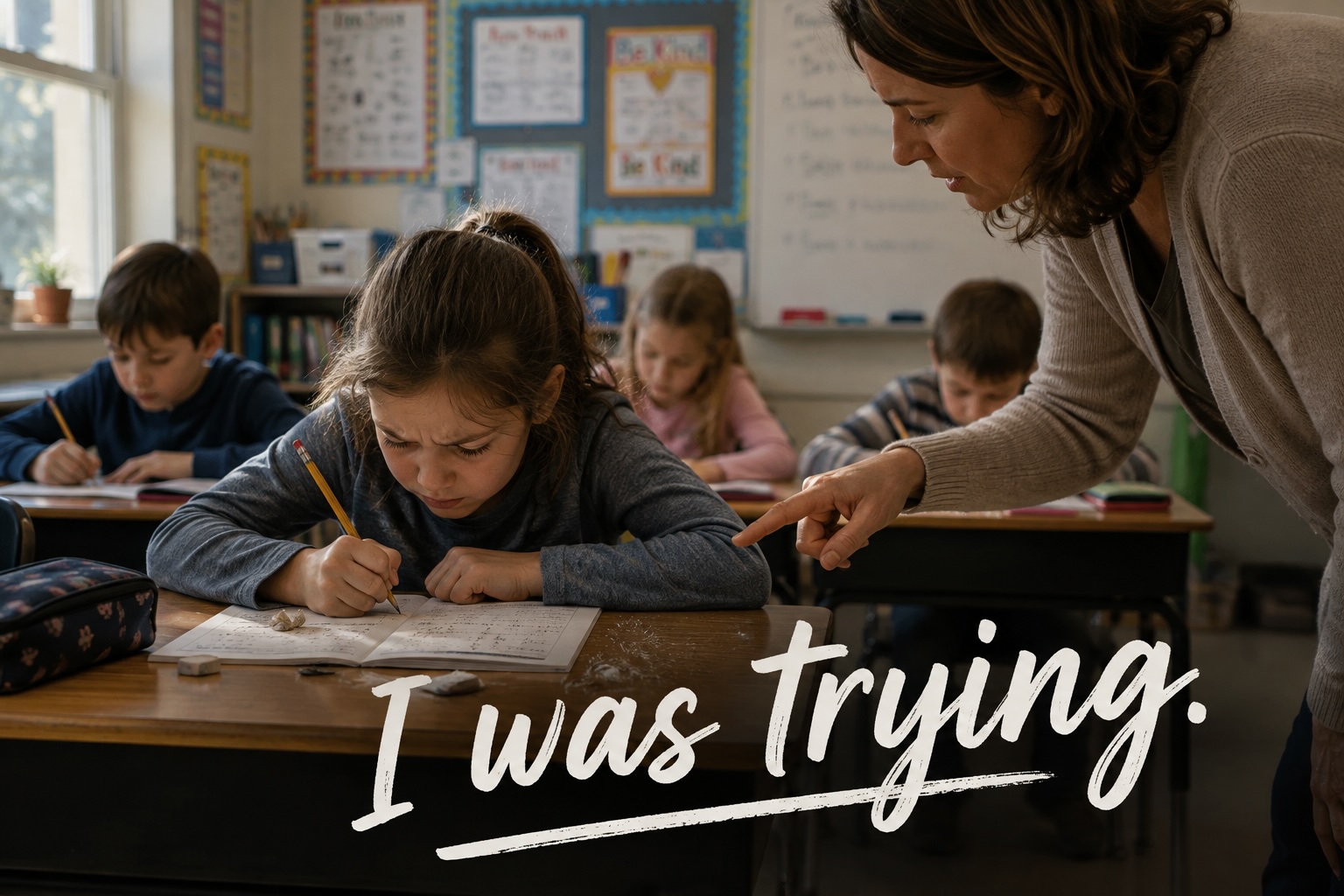
“But I was trying.”
Perhaps one of the most painful experiences for many people with ADHD is this:
They were trying. They genuinely meant to remember. They genuinely intended to tidy their room. They wanted to hand in the homework. They planned to leave on time. They promised themselves they wouldn’t interrupt again. And yet they still forgot.
Imagine hearing:
“You didn’t even try.”
when you know you really did.
For a child, this is incredibly confusing.
Before diagnosis, there is no explanation for why these things keep happening. Children don’t know about working memory. They don’t understand executive functioning. They don’t know why boring tasks can feel physically difficult to begin while they can spend hours completely absorbed in something they love.
They simply know that everyone else seems to manage these things more easily than they do.
Eventually, children start searching for explanations.
If nobody explains how their brain works, they often create their own story.
“Maybe I’m lazy.”
“Maybe I’m selfish.”
“Maybe I’m disappointing everyone.”
“Maybe there’s something wrong with me.”
Those beliefs don’t appear overnight. They develop slowly, through repeated experiences of trying, failing and being misunderstood.
Read more: “I Didn’t Mean to Do It”: Understanding ADHD Impulsivity Through a Child’s Eyes
When parents are neurodivergent too
There is another layer to this story that isn’t discussed nearly enough.
ADHD is highly heritable. Many children with ADHD are raised by parents who are also neurodivergent, whether diagnosed or not.
This doesn’t mean neurodivergent parents are bad parents.
Far from it.
Many are exceptionally creative, compassionate and deeply devoted to their children.
But parenting while managing your own ADHD can be exhausting.
Imagine a parent who is already overwhelmed by work, struggling to stay organised and trying desperately not to forget everything they need for the morning.
Now their child can’t find their shoes.
Again.
The child becomes emotionally overwhelmed. The parent is already emotionally overwhelmed. Neither nervous system has much capacity left.
What looks like “overreacting” may sometimes be two dysregulated nervous systems colliding.
There may also be something even more complicated happening.
Some parents spent their own childhoods hearing:
“You’re lazy.”
“Get yourself organised.”
“Why can’t you be more like your brother?”
Years later, when their child struggles with exactly the same things, it may unknowingly trigger memories of their own shame.
Their frustration isn’t only about today’s forgotten PE kit. It may also be connected to decades of feeling they themselves weren’t good enough.
That doesn’t excuse harsh reactions. But it does help explain why some family patterns repeat across generations.
School: where difference often becomes visible
Parents are only part of the story. Children also spend thousands of hours at school. Teachers have enormous responsibilities. They manage classrooms, support learning and often have limited time and resources.
But school is also where ADHD differences frequently become highly visible.
Children are expected to sit still.
Wait their turn.
Follow instructions.
Remember homework.
Manage time.
Organise equipment.
Work independently.
These are precisely the skills many children with ADHD find hardest.
As a result, they often receive more corrections than their classmates.
Sometimes they become “the chatty one”.
“The forgetful one.”
“The messy one.”
Or the child with “so much potential if only they applied themselves.”
For girls and children with predominantly inattentive ADHD, the experience may look different. They may not be disruptive. Instead, they quietly miss instructions, daydream, work twice as hard to keep up and blame themselves when they still fall behind. Because they attract less attention, their struggles may go unnoticed for years. The shame, however, can be just as powerful.
The hidden cycle nobody notices
Over time, something begins to happen.
ADHD leads to more mistakes. More mistakes lead to more correction. More correction creates more stress and self-doubt. Stress makes executive functioning even harder. Which leads to more mistakes.
Without realising it, children can become trapped in a cycle that reinforces itself. It isn’t simply the ADHD that becomes difficult. It is the emotional environment that gradually develops around it.
This is one reason why understanding ADHD early can be so important. Not because it removes every challenge. But because it changes the meaning attached to those challenges.
When criticism becomes your own voice
Eventually, something changes. Other people no longer need to criticise you. You start doing it yourself.
Many adults with ADHD describe an inner voice that is relentless.
“You’re going to mess this up.”
“Everyone else manages.”
“Don’t let anyone see how disorganised you really are.”
“You have to work twice as hard.”
This may help explain why so many adults with ADHD develop perfectionism, people-pleasing, chronic overworking or masking. These patterns are often misunderstood as personality traits.
Sometimes they are survival strategies. If you spent years expecting criticism, your brain learns to anticipate it.
You double-check everything.
You overprepare.
You apologise constantly.
You explain yourself in exhausting detail.
You become terrified of making mistakes.
The criticism that once came from outside gradually becomes internal.
Perhaps diagnosis changes something even more important than medication
We often talk about the benefits of an ADHD diagnosis in terms of medication, school support or workplace adjustments. Those things matter enormously.
But perhaps diagnosis changes something even more fundamental. It changes the story.
Instead of:
“He’s lazy.”
It becomes:
“He’s struggling to get started.”
Instead of:
“She doesn’t care.”
It becomes:
“She’s forgotten because her working memory lets her down.”
Instead of:
“They’re being difficult.”
It becomes:
“They’re overwhelmed.”
That shift changes conversations. It changes expectations. It changes relationships. Perhaps most importantly, it changes how a child begins to understand themselves.
Diagnosis doesn’t remove responsibility. Children still need to learn skills, routines and ways of managing their ADHD. But responsibility built on understanding looks very different from responsibility built on shame.
This isn’t about blame
It is important to say this clearly.
Most parents love their children deeply.
Most teachers genuinely want children to succeed and try to understand them.
Many adults who raised today’s late-diagnosed ADHD adults simply didn’t have the information we have now.
Looking back isn’t about assigning blame.
It’s about recognising patterns that were invisible at the time.
Understanding those patterns gives us an opportunity to do something different for today’s children and for ourselves.
Growing up in trouble isn’t the same as being a troubled child
Many adults with ADHD spend years trying to fix themselves.
Trying to become less forgetful.
Less emotional.
More organised.
More disciplined.
More like everyone else.
But perhaps the first step isn’t fixing. Perhaps it is understanding. Understanding that many of the beliefs you carry about yourself may not have come from your ADHD alone.
They may also have been shaped by years of being misunderstood. Growing up in trouble doesn’t necessarily mean you were a difficult child. Sometimes it simply means you grew up with a brain that other people didn’t yet know how to understand.
And once you understand that, something important becomes possible.
You can begin to question whether the voice telling you that you’re lazy, careless or never good enough was ever really yours in the first place.
Dana Dzamic
Neurodiversity consultant and ADHD coach
Founder of ADHD Insight Hub